

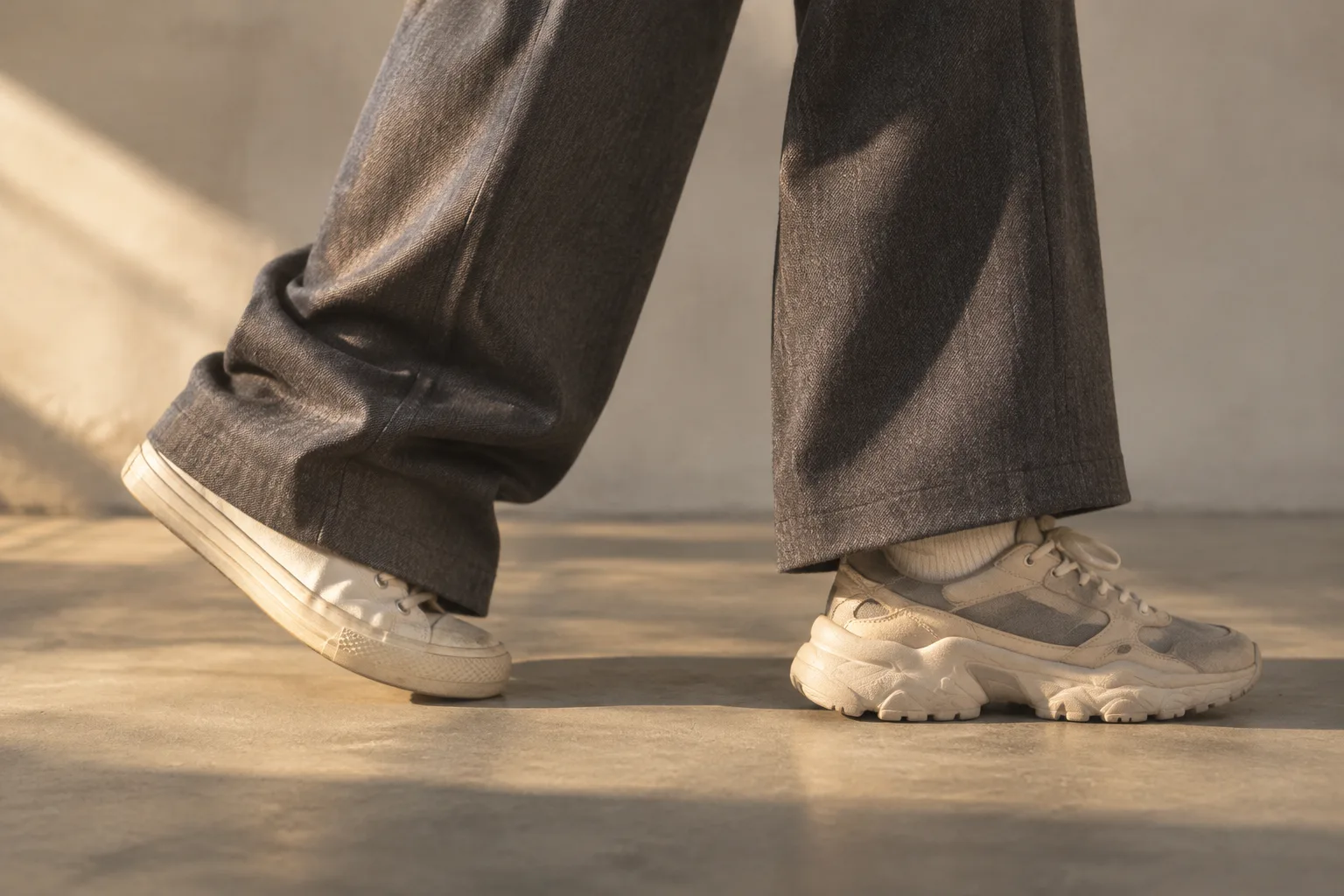
Wide Trousers and Sneakers: Getting Proportions Right
Wide trousers and sneakers look wrong for one reason, and it is almost never the trousers. A pair of pleated wool trousers that grazes the shoe and a pair of slim canvas sneakers that vanish underneath it produce a silhouette that reads as two unrelated objects stacked in the same photograph. The trousers are doing one thing. The shoes are doing another. Nothing in the middle reconciles them.
The reconciliation happens at the hem, and the hem is where most outfits fail. A wide leg needs a shoe with enough visual mass to catch the fall of the fabric and hold it. A low-profile sneaker cannot do that job. It disappears, the trouser pools on top of it, and the whole lower half turns into a triangle with no base.
This is a proportion problem, and proportion problems have solutions. They are just not the solutions most style writing offers, which tend to be some version of "wear what feels right" followed by a photograph of someone who could wear a burlap sack and look fine.
The Hem Is a Load-Bearing Line
Think about what a wide trouser hem actually is. It is a horizontal line of fabric, often 9 or 10 inches across on a size medium, floating somewhere around the ankle. That line is heavy. It carries the weight of the leg above it, and it needs a visual anchor beneath it or the eye keeps traveling down and finds nothing.
A chunky sneaker provides that anchor. A slim leather sneaker does not. A canvas plimsoll with a 1 inch rubber sole does not. The trouser hem hangs there, the shoe recedes, and the leg reads as a column with a small smudge at the bottom.
The fix is straightforward: either the shoe gets bigger or the hem gets closer to it. Very often both.
Sole Thickness and Trouser Width Move Together
A useful rule, crude but reliable: the sole of the sneaker should be roughly as thick as the trouser hem is wide, measured in a rough visual sense. A 10 inch hem wants a sneaker with a substantial midsole, something in the 1 to 1.5 inch range, and a generous toe box. A 7 inch hem, which is a moderate wide leg rather than a true wide, can carry a slimmer shoe.
This is why the pairing of wide wool trousers with a chunky retro runner works and the pairing with a thin canvas sneaker does not. The runner has volume at the bottom. The canvas sneaker has almost none. The trouser needs to sit on something.
There is a second variable here, which is the shape of the toe. A rounded, bulbous toe box pushes the sneaker forward visually and gives the hem a platform to break against. A narrow, tapered toe, the kind on a sleek leather sneaker, makes the shoe look even smaller under a wide leg, because the eye follows the taper inward and down.
Break, No Break, and the Half-Break That Actually Works
Tailoring language gives three options. A full break means the trouser folds once over the shoe. A half break means it just touches. No break means it ends clean above the shoe with a sliver of sock or ankle visible.
With wide trousers and sneakers, the full break is the dangerous one. A wide leg folding over a low sneaker creates a puddle of fabric that swallows the shoe entirely and shortens the leg. The no-break version works better than most people expect, because it lets the hem hang straight and shows the shoe, but it demands a fairly precise length and a sneaker with enough presence to justify the exposure.
The half break is the forgiving middle. The hem kisses the top of the sneaker, the fabric sits clean, and the shoe gets enough of a read to anchor the leg. It is also the easiest to tailor to, because a half inch of adjustment in either direction does not ruin the line.
Practical note: wide trousers break differently depending on the fabric. A stiff cotton or a heavy wool holds its shape at the hem and can carry a slightly longer length. A fluid viscose or a lightweight linen collapses and needs to be shorter, or the hem turns into a soft pile on top of the shoe.
The Sneaker Categories That Carry a Wide Leg
Three families of sneaker do the work. The first is the chunky retro runner, the kind with a substantial EVA midsole and a mesh-and-suede upper. These have the volume, the toe box, and the visual weight. They also tend to be a little taller, which helps.
The second is the court sneaker in a heavier build, leather or suede, with a cupsole rather than a vulcanized sole. The cupsole adds 1 to 1.25 inches of height and a clean edge at the bottom of the trouser. A leather court shoe in white or off-white with a wide trouser is one of the most reliable combinations available.
The third is the trail or hiking-inspired sneaker, which has both volume and a slightly aggressive sole profile. These work best with wider, more casual trousers, cotton twill or heavy canvas, and they can look forced under a fine wool trouser.
What sits outside the list: thin vulcanized canvas sneakers, low-profile running shoes with a narrow last, and anything with a sole under three quarters of an inch. These are not bad shoes. They are simply the wrong tool for this particular trouser.
Sock Length Changes the Whole Equation
A wide trouser with a no-break hem and a visible ankle is a very different outfit from the same trouser with a sock pulled up. The visible ankle reads lighter, more summery, more casual. The sock reads intentional and slightly more formal.
With a half break, the sock is mostly hidden and the question becomes moot. With a full break, the sock is entirely hidden and the trouser is doing all the talking. The sock matters most in the no-break case, where a ribbed crew sock in a color that picks up something in the outfit can tie the shoe to the trouser and stop the ankle from looking accidental.
There is a school of thought that a wide trouser and a sneaker should always show a sock, to signal that the pairing is deliberate. It is a reasonable instinct, and it works well with cropped wide trousers, the kind that end above the ankle by design. With a full-length wide trouser, the sock question mostly resolves itself.
Where the Waist and Rise Enter the Proportion
The hem gets all the attention, but the rise does half the work. A high-rise wide trouser lengthens the leg and gives the hem more room to fall cleanly. A low-rise wide trouser shortens the leg and makes the same hem look sloppy, because the proportion above and below the knee is already off.
With sneakers specifically, a high rise and a slightly tapered wide leg (wide through the thigh, gently narrowing to the hem) is the most forgiving shape. It keeps the volume without turning the leg into a rectangle, and it gives the sneaker a clear line to sit under.
A fully straight wide leg, the kind that hangs like a curtain from hip to hem, is harder. It needs either a very substantial sneaker or a very precise hem length, and it offers no margin for error. It can look extraordinary when it works and like borrowed clothing when it does not.
Color, Contrast, and the Line at the Ankle
A dark wide trouser over a white sneaker creates a hard horizontal break at the ankle. That break is a proportion tool. It says: the leg ends here, the shoe begins here, and the eye can rest on the contrast.
A tonal pairing, grey trouser over grey sneaker, softens the break and makes the leg read as a single long line. That is a different effect, and it is usually better for shorter wearers, because it extends the leg visually.
The mistake is a mid-tone shoe under a mid-tone trouser with a low sole: the colors blend, the shoe disappears, and the hem floats. High contrast or low contrast both work. Mushy contrast does not.
The Tailor Visit That Solves Most of This
Most wide trousers are sold at a length designed for a heel, not a sneaker. Taking them up an inch or an inch and a half and asking for a half break costs very little and fixes the majority of the proportion problems described above. The tailor needs to see the sneaker, or at least know its sole height, because the hem should be set to the shoe it will be worn with.
This is the unglamorous part of getting the look right, and it is the part that separates a photograph of an outfit from an outfit someone actually wears. The trousers are the same trousers. The shoes are the same shoes. The half inch of hem is the difference.