

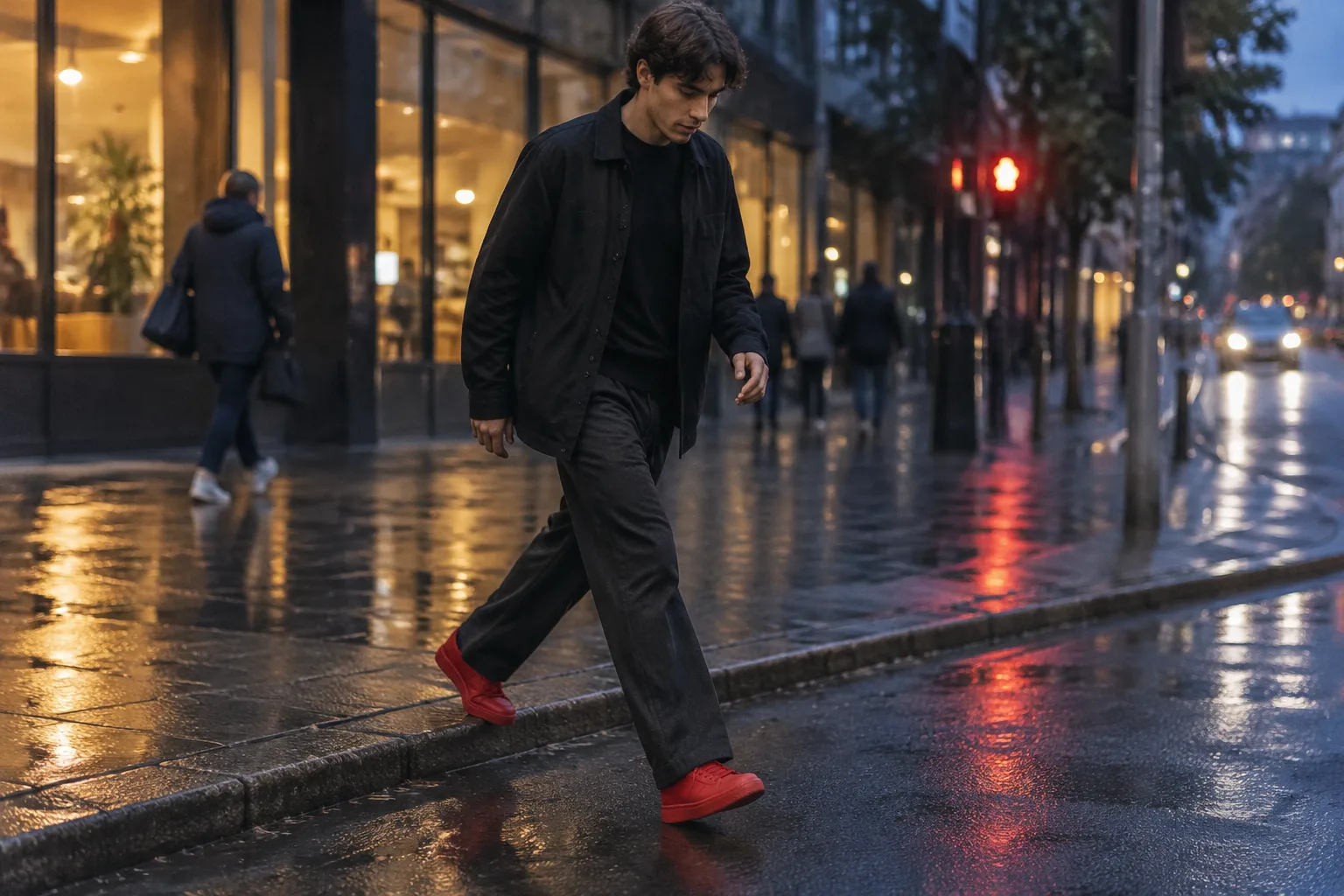
All-Black Outfits, One Bright Shoe: Color Choices That Land
A black outfit with one bright shoe is a decision about where the eye lands first. Everything above the ankle goes quiet, and the foot delivers the sentence. It works because the contrast is concentrated at the bottom of the body, where movement draws the gaze anyway. A person walking through a room in charcoal trousers and scarlet loafers has already told the room something before saying a word.
The trick is not simply owning a red shoe. Plenty of red shoes sit unworn in closets because their owners could not work out what to wear them with, and the answer is usually the same: almost everything black, and nothing else competing. The all-black base is the frame. The shoe is the painting. Get the frame wrong and the painting looks like a mistake.
Why the Foot Is the Right Place for the Only Color
Color placed at the foot reads as deliberate because it sits far from the face. A bright scarf or a bright lip competes for attention with the eyes and the expression. A bright shoe sits at the end of a long vertical line, and the eye travels down to it rather than being ambushed by it. The effect is confident without being loud.
There is also a practical argument. Black clothing absorbs the ordinary wear of a day: the coffee splash, the seat on the train, the rain. A bright shoe does not hide anything, but it does not need to. It is meant to be seen, and a small scuff on a patent leather toe reads as character rather than damage. The shoe is allowed to look lived in.
The silhouette matters more than the shade. A bright flat in a slim shape, a low block heel, a pointed pump, all keep the line clean. A bright chunky sneaker in the same color reads as sporty and casual, which is a different sentence entirely. The color is the headline; the shape decides the tone of voice.
Choosing the One Color That Carries the Outfit
Red is the default for a reason. A true red, not burgundy and not tomato, holds its own against black without muddying. It reads warm, it photographs well, and it survives the shift from daylight to lamplight without turning brown. A red pump with black trousers and a black turtleneck is close to a uniform, and a good one.
Cobalt blue is the quieter choice and often the more interesting one. Against black it looks almost electric, and it flatters most skin tones because it sits cool and clean. Cobalt loafers with black wool trousers and a black coat feel like a private joke: sober from the knees up, alive from the ankles down.
Mustard and ochre are harder to place. They lean warm and slightly retro, and against black they can go from rich to muddy depending on the light. Mustard suede boots with black denim work because the texture of the suede softens the color. Mustard patent leather tends to shout, and shouting is not the same as landing.
Green is the sleeper. A deep emerald or a grassy kelly green against black looks expensive in a way that red rarely does, because red is expected and green is not. Green suede loafers with black trousers and a black knit have a slightly academic air, like a professor who knows exactly what they are doing.
Pink and orange are for the wearer who wants the shoe to be the event. A hot pink flat with an all-black outfit is a statement that the day is not going to be ordinary. Orange, especially a burnt orange or a clementine, works in summer with black linen and looks like a holiday even on a Tuesday. The risk with these colors is not the color itself; it is the temptation to add a second bright thing somewhere else.
The Black Has to Be Actually Black
A common failure is a black base that is not quite black. Charcoal trousers, a faded black tee, a navy-tinged coat, and then a bright shoe. The result looks accidental, as if the wearer ran out of dark clothes and grabbed the only clean pair of shoes. The base needs to be consistent: true black, or a deliberate near-black like ink or oxblood, repeated across the outfit.
Texture keeps an all-black outfit from going flat. Wool trousers, a cotton tee, a leather belt, a suede shoe: the eye reads the differences in surface even when the color is the same. Without texture, black becomes a silhouette, and a silhouette with one bright shoe can look like a costume. With texture, it looks like a wardrobe.
Fit does the same work. A black outfit that fits properly, with a trouser that breaks at the right place and a shoulder that sits where it should, gives the bright shoe a clean line to sit under. A sloppy black outfit with a bright shoe looks like a uniform with a mistake in it. The shoe cannot rescue the clothes; it can only finish them.
Matching the Shoe to the Occasion
An all-black outfit with a bright shoe is not one look; it is a family of looks, and the venue decides which member shows up. In an office with a formal bent, the shoe should be a closed toe, a low heel, and a color that reads as considered rather than playful. A deep red or a forest green in a leather pump or a leather loafer sits comfortably at a desk without asking for comment.
In a casual setting, the same logic loosens. A bright sneaker, a bright mule, a bright ankle boot with black jeans and a black sweater. The shoe can be louder because the clothes are already saying "off duty." The contrast reads as ease rather than effort.
Evening is where the bright shoe earns its keep. A black dress or a black suit with a metallic or jewel-toned shoe looks deliberate in a way that an all-black shoe does not, because the color catches the low light and gives the eye something to hold. A black outfit with a black shoe is elegant but static. The same outfit with a single bright shoe has a pulse.
What Not to Pair With the Bright Shoe
The most common mistake is a second bright element. A bright shoe and a bright bag, or a bright shoe and a bright belt, splits the eye's attention and turns a sharp idea into a busy one. The whole point of the single bright shoe is that it is the only thing doing that job. Add a second and the first loses its authority.
Another mistake is a bright sock. A bright shoe with a bright sock poking out at the ankle creates a stripe of color that fragments the leg line. The cleanest version is a black sock or a nude sock that disappears, so the shoe sits directly against the trouser hem. The color should arrive at the foot without a preview.
Jewelry can be the quiet accomplice. A single gold hoop or a thin silver chain does not compete with the shoe because it sits in a different register: small, metallic, close to the body. The shoe is the loud one. Everything else is allowed to be a whisper.
The Shoe as a Repeatable Decision
The real value of this formula is that it removes a daily decision. A person with a black wardrobe and three bright shoes has effectively tripled the number of outfits available without buying a single new garment. Monday is the red loafer. Tuesday is the cobalt pump. Wednesday is the green flat. The clothes stay the same; the mood changes at the ankle.
This is why the bright shoe tends to become a signature rather than a one-off experiment. It is easy to repeat, easy to recognize, and easy to defend when someone asks about it. The answer is always the same: everything else is black, and the shoe is the one thing that is not.
A woman in a black coat and red shoes crossing a wet street in November is a small, complete picture. The coat is the weather; the shoes are the argument. That is the whole proposition, and it does not need a second color to make its case.