

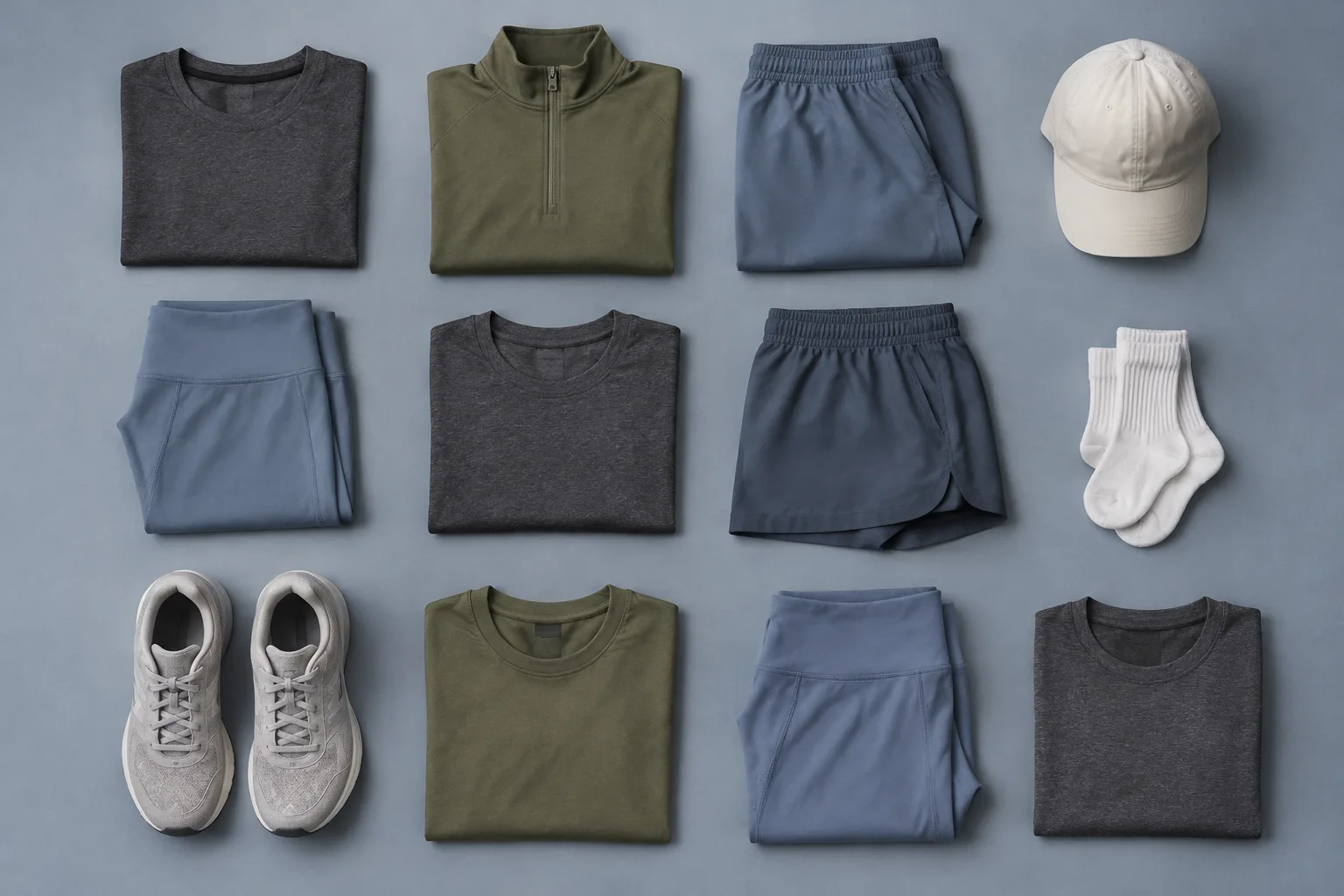
A Sporty Capsule: Fewer Pieces, Sharper Outfits
A sporty capsule wardrobe begins with a hard subtraction. Most people who try to dress athletically end up with a drawer full of mismatched tech fabric: a race-day singlet bought on impulse, three pairs of shorts in slightly different cuts, a jacket that only works in one temperature band. The capsule idea, borrowed from the fashion world, asks for a smaller set of pieces that all speak to each other. In a sporty context that means fewer items, each chosen for a specific job, and a color and fabric logic that lets any top work with any bottom.
The payoff is not minimalism as an aesthetic. It is speed. A runner with twelve well-chosen pieces can dress for a cold morning, a tempo session, and a coffee afterward without standing in front of a drawer at 6:10 a.m. deciding which shorts go with which shirt. Fewer pieces, chosen harder, produce sharper outfits because every combination has already been vetted.
The four-slot structure that replaces a full drawer
A workable sporty capsule runs on four slots: bottoms, tops, an outer layer, and footwear. The count inside each slot stays low. Two pairs of shorts (one liner, one loose), one pair of tights, two tops (one sleeveless, one long-sleeve), one midlayer, one shell, one pair of trainers, one pair of cross-trainers for the gym. That is ten to twelve pieces and it covers most of a training week.
The structure matters more than the exact number. The slots force a decision about redundancy. Two pairs of black shorts in the same length are not a capsule; they are a duplication. One pair of shorts with a liner for speed work and one looser pair for easy days is a capsule. The difference is function, and function is what keeps the count honest.
Why color discipline does more work than piece count
The single most useful rule in a sporty capsule is a two-color base plus one accent. Pick a dark neutral (black, navy, charcoal) and a light neutral (white, bone, light grey), then one accent that appears sparingly. Every top and bottom lives in the base. The accent shows up on a cap, a pair of socks, a shell, or a single top.
This is where most athletic wardrobes fail. A bright orange singlet and neon green shorts each look fine alone and terrible together. A capsule with a strict base eliminates that failure mode before it happens. The wearer never has to think about whether the pieces clash, because the palette has already answered the question.
There is a practical side benefit. Dark bottoms hide sweat and road grime. Light tops reflect heat on summer runs. The color logic and the climate logic point in the same direction, which is a rare alignment worth using.
Fabric choices that survive repeated washing
A sporty capsule gets washed constantly, far more than a fashion capsule. That means fabric durability is not a luxury; it is the constraint that determines whether the capsule lasts a season or three. Look for synthetics with a tight knit and a bit of spandex, merino for tops that need to resist odor across multiple wears, and a shell with a laminated membrane rather than a coating that flakes after a dozen washes.
The failure points are predictable. Cheap polyester pills at the underarm and crotch. Coated jackets delaminate. Elastic waistbands lose stretch. A capsule built from pieces that survive two hundred wash cycles is smaller in the long run than one built from pieces that die in twenty. The number on the tag is less important than the number of washes the garment can take.
The layering math for a forty-degree morning
Cold-weather running is where a capsule earns its keep. A forty-degree Fahrenheit morning (about four to five Celsius) is the classic tricky temperature: too warm for a heavy jacket, too cold for shorts and a tee. The capsule answer is a base layer, a midlayer, and a shell, each removable in sequence as the body warms.
Start with a long-sleeve merino or synthetic base. Add a light grid fleece or a technical hoodie. Top with a wind-resistant shell that packs into a pocket. Gloves and a beanie live in the same slot system. On a forty-degree start that turns into a fifty-degree finish, the shell comes off first, then the midlayer, and the base layer carries the rest of the run. Three pieces, worn in three configurations, cover a temperature swing that would otherwise require three separate outfits.
The same logic works in reverse for heat. A sleeveless top, a light cap, and a pair of shorts are the entire hot-weather kit. The capsule does not need a separate summer wardrobe; it needs the summer configuration of the same pieces.
Footwear is the piece that refuses to capsule
Shoes break the capsule rules, and pretending otherwise causes injury. A single pair of trainers cannot serve a long slow run, a track session, and a gym lift without compromise. The cushioning that protects a ten-mile easy run makes a tempo run feel mushy. A flat gym shoe lacks the stack height for road mileage.
The honest capsule keeps two pairs: one daily trainer for easy mileage and one faster shoe for workouts, plus a flat cross-trainer if the gym is part of the week. That is three pairs, and it is the correct number. A capsule that tries to compress footwear to one pair saves money and costs knees.
What gets cut, and what gets kept as a wildcard
The pieces that get cut from a sporty capsule are the ones bought for a single event: the race singlet with the date printed on it, the novelty socks, the jacket from a destination marathon. These are sentimental, and sentiment has its place, but it does not belong in the working drawer. Move them to a box.
One wildcard is allowed. A single piece that breaks the palette or the slot count, chosen because it makes the wearer happy. A bright cap. A pair of patterned shorts. The wildcard is the pressure valve that keeps the capsule from feeling like a uniform, and one is enough. Two wildcards and the system collapses back into a drawer of mismatched gear.
The gym-to-street transition piece
A sporty capsule that stays inside the gym is a smaller idea than it needs to be. The best capsules include one piece that crosses into the rest of the day: a pair of tapered joggers in a dark technical fabric, a clean hoodie without a loud logo, a cap that reads as neutral. These are the pieces that let a person leave the gym and run an errand without changing.
The transition piece has to pass a simple test. It should look intentional in a coffee shop and functional on a treadmill. Technical joggers with a zip pocket and a clean line pass. Basketball shorts with a giant logo do not. The capsule gets sharper when the boundary between training and the rest of life softens by exactly one outfit.
A ten-piece list, written out
Two pairs of shorts (one lined, one loose). One pair of tights. One sleeveless top. One long-sleeve top. One midlayer. One shell. One pair of joggers. One cap. One pair of daily trainers and one faster shoe. That is the working core, and it fits in a single drawer with room to spare.
The list is not sacred. A cyclist swaps the tights for bib shorts. A lifter swaps the shell for a warm-up jacket. The structure holds: two bottoms, two tops, a layer, a shell, a transition piece, a cap, and shoes. The count stays near ten, and the palette stays near three colors. Everything else is variation.
The drawer that closes without a shove
The test of a sporty capsule is physical. The drawer should close without a shove. The hamper should fill at a predictable rate. The morning decision should take under thirty seconds. When those three things are true, the capsule is working, and the outfits are sharper because every piece was chosen to earn its slot.
A runner who has pared down to ten pieces and three colors will still reach for the same navy shorts and grey long-sleeve on a cold Tuesday. The difference is that the choice is fast, the combination is already proven, and the drawer has room for the one bright cap that makes the whole thing feel like a person rather than a kit. Fewer pieces, chosen harder, produce the sharper outfit every time the alarm goes off before dawn.