

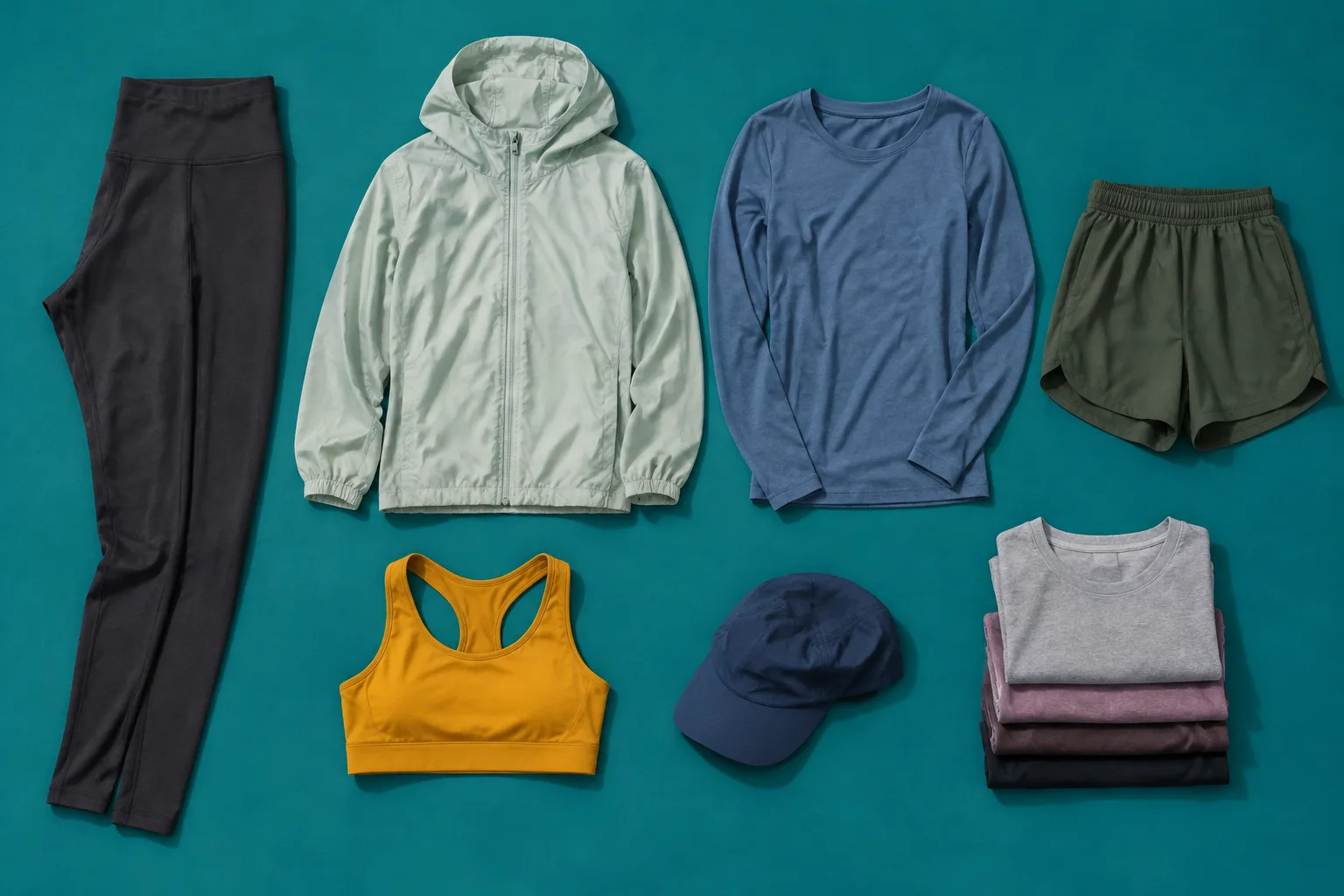
What a Working Athleisure Capsule Actually Needs
The athleisure capsule has a marketing problem, and the marketing problem is that it sounds like a wardrobe plan for people who do not actually sweat. Leggings that cost as much as a dinner, a matching set in a color called sage smoke, a "curated" rail of fourteen pieces that all photograph the same. That version of the capsule is real, and it sells, and it is mostly useless to the person who wants to wear one set of clothes from a 6 a.m. run through a grocery store stop and into a desk chair by nine.
A working athleisure capsule is a different animal. It is a small, hard-used rotation of pieces that survive being laundered constantly, that layer without bulk, and that do not announce "gym" so loudly that they cannot be worn anywhere else. The word doing the heavy lifting is working. Capsules built for photographs fail on the third wash. Capsules built for work get better with use.
The capsule has to survive the laundry cycle, not the mirror check
Here is the number that should drive the whole plan: a capsule worn three or four times a week gets washed almost as often. If a piece needs to be air-dried flat, hand-washed cold, or kept away from the dryer, it is not in the capsule. It is a guest. A guest can visit once a week. A capsule piece lives in the rotation, and the rotation runs through a machine.
This single constraint eliminates most of the expensive stuff. Merino blends go. Silk-touch fabrics go. Anything with a delicate finish on the surface goes. What remains is the unglamorous core: dense cotton-blend jersey, nylon-elastane woven fabric, polyester fleece that holds its shape, and a small number of knits with enough body to survive a spin cycle without turning into a rag.
The test is unromantic. Buy one piece, wash it ten times the way the wearer actually does laundry, and look at the seams. Pilling at the underarm, a hem that has gone wavy, a waistband that has lost its snap. Those are the failure points, and they show up early. A capsule built from pieces that pass the ten-wash test will outlast a capsule built from pieces that pass the mirror check by years.
Bottoms carry the whole system, so they get the most budget
Most capsule advice spends its ink on tops, because tops are photogenic. In practice, the bottoms decide whether the capsule works. A pair of leggings that goes sheer at the knee when the wearer squats is a pair of leggings that cannot leave the house. A jogger whose cuff is too tight reads as gym wear from across the room. The bottoms set the register for every outfit built on top of them.
Three bottoms will cover almost everything. One pair of high-rise, opaque leggings in a dark neutral, chosen for a fabric weight that does not show every seam of what is underneath. One pair of tapered joggers with a clean cuff and a waistband that does not bunch. One pair of wide-leg or straight-leg pants in a ponte or heavy jersey that reads as real trousers from a distance and behaves like sweatpants up close. That last pair is the piece that lets the whole capsule cross from the trail into the office without a change of clothes.
Fit matters more here than anywhere else. Leggings should be snug at the waist and hip and relaxed through the calf, so the fabric is not fighting the body at every joint. Joggers should sit at the natural waist and taper only below the knee. The wide-leg pair should break just above the shoe. None of these are style opinions. They are the difference between a piece that gets worn forty times and a piece that gets worn four.
Tops in three weights, and the middle weight is the one that matters
The useful structure for tops is by warmth, not by style. A thin base layer, a midweight long sleeve, and a heavier layer that can be removed. That is it. Three weights cover a run in cool weather, a full day of errands, and a flight where the cabin temperature is a rumor.
The midweight long sleeve is the load-bearing piece, and it is the one most capsules underbuy. It needs to be substantial enough to wear alone without looking like underwear, breathable enough to survive a brisk walk, and neutral enough to pair with every bottom in the rotation. A crew neck in a dark heather, in a cotton-poly blend with a little stretch, will get worn more than any other item in the wardrobe. Buy two of the same one.
The base layer should be thin, close to the body, and quick to dry. The heavier layer should be a half-zip or a full-zip that opens wide enough to dump heat fast. A zip that only opens to the sternum is a zip that does half its job. On a cool morning walk that turns into a warm afternoon, the full-zip gets unzipped and tied around the waist; the half-zip gets carried.
Outer layers do the transition work between gym and street
The piece that makes athleisure read as a deliberate outfit is almost always the outer layer. A good jacket over leggings and a long sleeve changes the whole silhouette. The same leggings under a hoodie and a puffer read as a person who has not gotten dressed yet. That distinction is worth a real budget line.
Two outer layers will cover the year. A lighter softshell or knit jacket for the shoulder seasons, cut long enough to cover the hip, with a collar that stands up against wind. And a warmer insulated layer for the cold months, ideally packable, with a hood that actually stays up. Both should be neutral enough to wear with every bottom, and both should have pockets deep enough that a phone does not slide out when the wearer sits down. That last detail is not trivial. It is the reason some jackets get worn daily and others stay on the hook.
The accessories are fewer than expected and do more than expected
A capsule does not need a drawer of accessories. It needs a small set that punches above its weight. One crossbody bag sized for a phone, keys, and a card, in a fabric that does not look precious. One cap that can be crushed into a pocket. One pair of shoes that works for a walk and a coffee shop, and a second pair for actual training. Socks in a single color, bought in bulk, so the pairing problem never arises.
The crossbody bag is the quiet hero. It turns leggings and a long sleeve into an outfit with a destination. It also frees the hands, which matters more than fashion writing usually admits. A person carrying a tote, a water bottle, and a phone is a person who looks like they are moving house, not running errands. The bag fixes that in one move.
Color discipline is what makes a small rotation look like a wardrobe
The fastest way to make eight pieces feel like twenty is to keep the palette tight. Pick two neutrals and one accent, and do not deviate. Black and charcoal with a single warm accent, or navy and stone with an olive accent. Every top should work with every bottom, which is only possible if the palette is small enough to memorize.
This is where capsule advice usually gets preachy, so it is worth being blunt. The palette is not a personality. It is a constraint that makes getting dressed fast. A person who loves color can still keep a working capsule; they just need to accept that the capsule is the base, and the color lives in the pieces worn on top of it, the scarf, the hat, the shoes. The capsule does not have to be the whole wardrobe. It has to be the part that never fails.
What to leave out, and why the omissions matter more than the inclusions
Most failed capsules fail because they include too much. The matching set that only works as a set. The cropped top that requires a specific rise on the bottom. The statement piece that pairs with exactly one other item. These are not bad clothes. They are bad capsule members, because a capsule is a system of interchangeable parts, and every piece that only works one way is a piece that wastes a slot.
Leave out the pieces that need special care, the pieces that only work in one season, and the pieces that require a specific undergarment to function. Leave out anything bought for a version of the wearer's life that does not exist, the aspirational running habit, the imagined weekend in the mountains. The capsule should fit the actual week, not the intended one.
The replacement rule keeps a capsule from quietly dissolving
A capsule does not stay a capsule on its own. It degrades one impulse purchase at a time, until the rail is full and nothing matches. The thing that prevents this is a replacement rule: when a piece wears out, it gets replaced with the same piece or its closest equivalent, not with something new and exciting. The rule sounds rigid. In practice, it is the only thing that keeps a small rotation small.
The rule also changes how a person shops. Instead of browsing for what is missing, the wearer buys the same midweight long sleeve again when the old one pills at the underarm, in the same color, in the same size. That is a boring transaction, and boring is the point. The capsule earns its keep by being predictable, and predictability is built by refusing to reinvent the rotation every season.
The final measure of a working athleisure capsule is not how it looks on a hanger. It is how quickly a person can get dressed on a dark morning, grab the bag by the door, and leave the house knowing every piece on their body will hold up through a run, a meeting, and the walk home. A capsule that passes that test does not need a marketing campaign. It just needs to be worn until the seams give out, and then replaced with the same thing.