

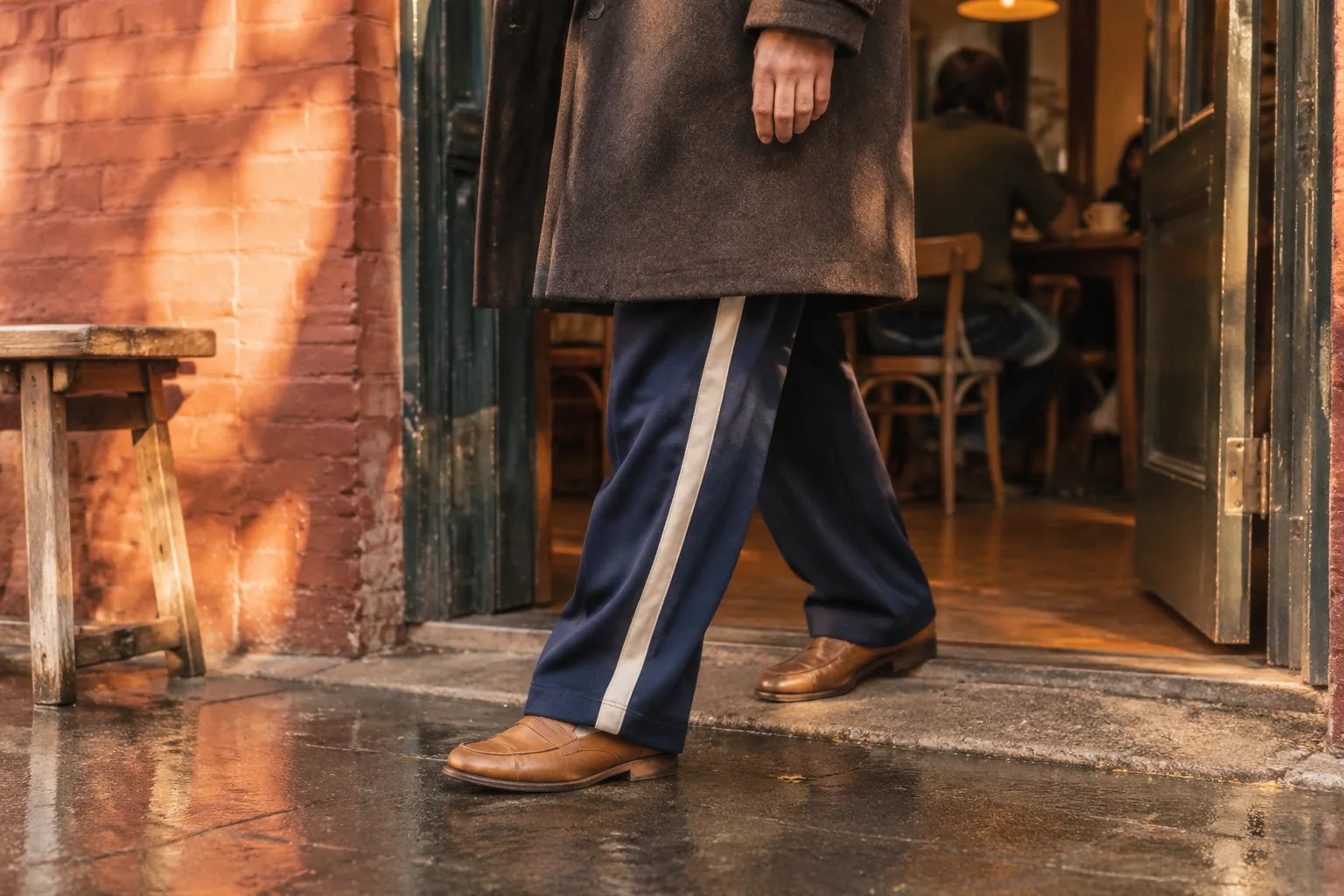
Track Pants in the City: A Field Guide to Looking Intentional
Track pants have spent four decades as the uniform of the gym, the dorm room, and the airport run at 5 a.m. That history is exactly what makes them hard to wear anywhere with a dress code. The fabric is forgiving, the cut is generous, and the associations are stubborn. A pair of navy polyester trousers with three white stripes down the leg carries a whole cultural load before the wearer has said a word.
Then, somewhere in the last several years, the silhouette migrated. It showed up under blazers at fashion week, on the legs of people waiting for espresso in expensive neighborhoods, paired with leather loafers and a structured coat. The migration was messy. Some attempts looked like a person who had given up on the bottom half of the outfit. Others looked genuinely sharp, and the difference between the two had almost nothing to do with money.
The difference was intent. A track pant worn with the rest of the outfit pulling in the same direction reads as a choice. A track pant worn as the path of least resistance reads as a mistake. The garment itself is neutral. The surrounding decisions do all the talking.
What Separates a Track Pant From a Sweatpant
The category has blurred, and that blur matters for anyone trying to build an outfit. A sweatpant is fleece, usually with a ribbed cuff and a loose, drooping seat. A track pant is woven, often a polyester or nylon blend, with a crisp hand and a slight sheen. The fabric is the first tell. Woven material holds a line; fleece collapses.
The second tell is the taper. A proper track pant narrows from the knee to the ankle and finishes with a gathered cuff or a zip. That narrowing creates a shape around the lower leg, which is why the silhouette can carry a heavier shoe or a cropped jacket. A sweatpant that pools over the shoe turns the whole leg into one soft column.
The third tell is the waistband. Elastic with a drawstring is standard, but the better versions have a flat front panel or a hidden channel that keeps the waist from bunching under a tucked shirt. Small construction details like this decide whether the pant can move into polite company.
The Side Stripe Problem
Nothing dates a track pant faster than a bold side stripe in a contrasting color. The triple stripe is iconic, and it is also the single most costume-like element in the entire wardrobe. Worn head to toe in matching kit, it reads as a team uniform. Worn with a tailored coat, it can read as an ironic joke that the wearer is not in on.
A quieter approach works better for city wear. Solid black, charcoal, navy, or a deep olive with a tonal stripe or no stripe at all gives the pant room to function as trousers. The shape still says athletic. The surface no longer shouts it. This is the version that survives a dinner reservation without a second thought.
There is a case for the loud stripe, but it requires commitment. If the stripe is going to be there, the rest of the outfit should lean into sport rather than fight it: a clean sneaker, a plain tee, a bomber. Half-sport and half-office produces the worst of both.
Choosing the Fabric Weight for the Season
Most track pants sold today are thin. The material is light enough to fold into a pocket and cheap enough to produce in volume, and it drapes like a curtain in a breeze. Thin fabric clings to the thigh and shows every seam of what sits underneath. For city wear, weight is the upgrade worth paying for.
A mid-weight woven with a bit of body hangs straight from the hip and keeps its shape through a full day of sitting and walking. In colder months, a brushed interior or a bonded lining adds warmth without bulk. In summer, an unlined version in a dry-handed fabric breathes better than the shiny stuff and photographs less like a track meet.
The hand-feel test is simple. Pinch the fabric between thumb and forefinger. If it slips away like plastic wrap, it will look cheap under any jacket. If it has a little grip and a dry surface, it will hold a crease and read as cloth.
The Shoe Decides Everything
Footwear is where a track pant either lands or falls apart. The gathered ankle creates a visible gap between the hem and the shoe, and whatever fills that gap sets the register for the whole look. A chunky running shoe pushes the outfit toward the gym. A sleek leather sneaker pulls it toward the street. A loafer or a derby pushes it into deliberate, slightly odd territory that can work beautifully.
The worst outcome is a thin, floppy sneaker with a visible sock gap. The ankle looks exposed and the pant looks borrowed. A slightly heavier shoe with some structure under it balances the taper and gives the hem something to sit against.
Boots work in winter, provided the shaft is narrow enough to meet the cuff cleanly. A zip hem helps here, since it can be opened to fall over the boot rather than bunching on top of it. The single rule: the transition from pant to shoe should look considered from three feet away.
Building the Outfit Above the Waist
The top half has to answer a question the pant cannot answer alone: what is this outfit for? A structured blazer, a crisp oxford, and a track pant create a deliberate tension between formal and casual that reads as modern when the fit is right. A hoodie and a track pant create no tension at all, which is fine for a weekend but reads as loungewear in any setting with a host.
Proportion matters more than category. A boxy, cropped jacket over a tapered track pant creates a clean triangle. A long, loose coat over the same pant creates a different, more relaxed line. Both work. What fails is a top that ends exactly at the hip with no shape, which turns the whole silhouette into a rectangle.
Tucking is a useful tool and an underused one. A plain tee or a fine-gauge knit tucked into the waistband shows the drawstring and the waist construction, which signals that the pant is being worn as trousers rather than as pajamas. A belt is usually unnecessary and often awkward with an elastic waist, but a clean tuck does the same work.
Color Palettes That Read as Clothing, Not Kit
The fastest way to make a track pant look like an intentional garment is to keep the palette restrained. Black on black, charcoal with cream, navy with gray, olive with rust. Two or three colors across the whole outfit, with the pant doing one of them. This is the same logic that governs any good wardrobe, applied to a garment that needs the help.
Matching sets are the exception that proves the rule. A tonal set in a single quiet color, worn with a contrasting shoe and a bag, can look like a designer tracksuit rather than a gym kit. The trick is the fit: the top should be cut close and the pant should taper, so the set reads as a silhouette rather than a sack.
Bright colors are possible but demanding. A single saturated track pant, worn with everything else in neutral, becomes the focal point and can carry a whole outfit. Two bright pieces at once turns the wearer into a billboard.
Fit Checks Before Leaving the House
The mirror test catches most problems. First, the hem: it should sit at or just above the ankle bone, not bunching on the shoe and not floating above the sock. Second, the thigh: the fabric should skim rather than cling, with enough room to pinch an inch at the side seam. Third, the seat: no pulling across the back, no sagging below the waistband.
A quick walk across the room reveals whether the waistband stays put or slides. Elastic waists that ride down are a fit problem, not a styling one, and no amount of layering fixes them. A drawstring tied properly, or a slightly higher rise, solves most of it.
Finally, check the pant against the shoe from a seated position. Cross one leg. If the hem rides up to mid-calf and exposes a long stretch of sock, the pant is too short for that shoe and the outfit will look off every time the wearer sits down.
Care That Keeps the Surface Intact
Woven synthetics are durable but unforgiving of heat. A hot dryer sets wrinkles and can leave a shine along the seams that never comes out. Cold wash, hang dry, and a low iron if needed will keep the surface matte and the shape intact for years.
Pilling along the inner thigh is the most common failure point, and it comes from friction rather than poor quality. A fabric shaver handles it in a minute. Ignoring it turns a good pair of pants into something that looks slept in, and the whole point of the exercise is to avoid that impression.
A track pant is a tool with a narrow range. Worn with intent, it turns a stiff city wardrobe into something with a little air in it. Worn carelessly, it announces that the wearer stopped deciding at the waist. The garment does not change between those two outcomes. The decisions around it do.