
The Windbreaker, After Hours
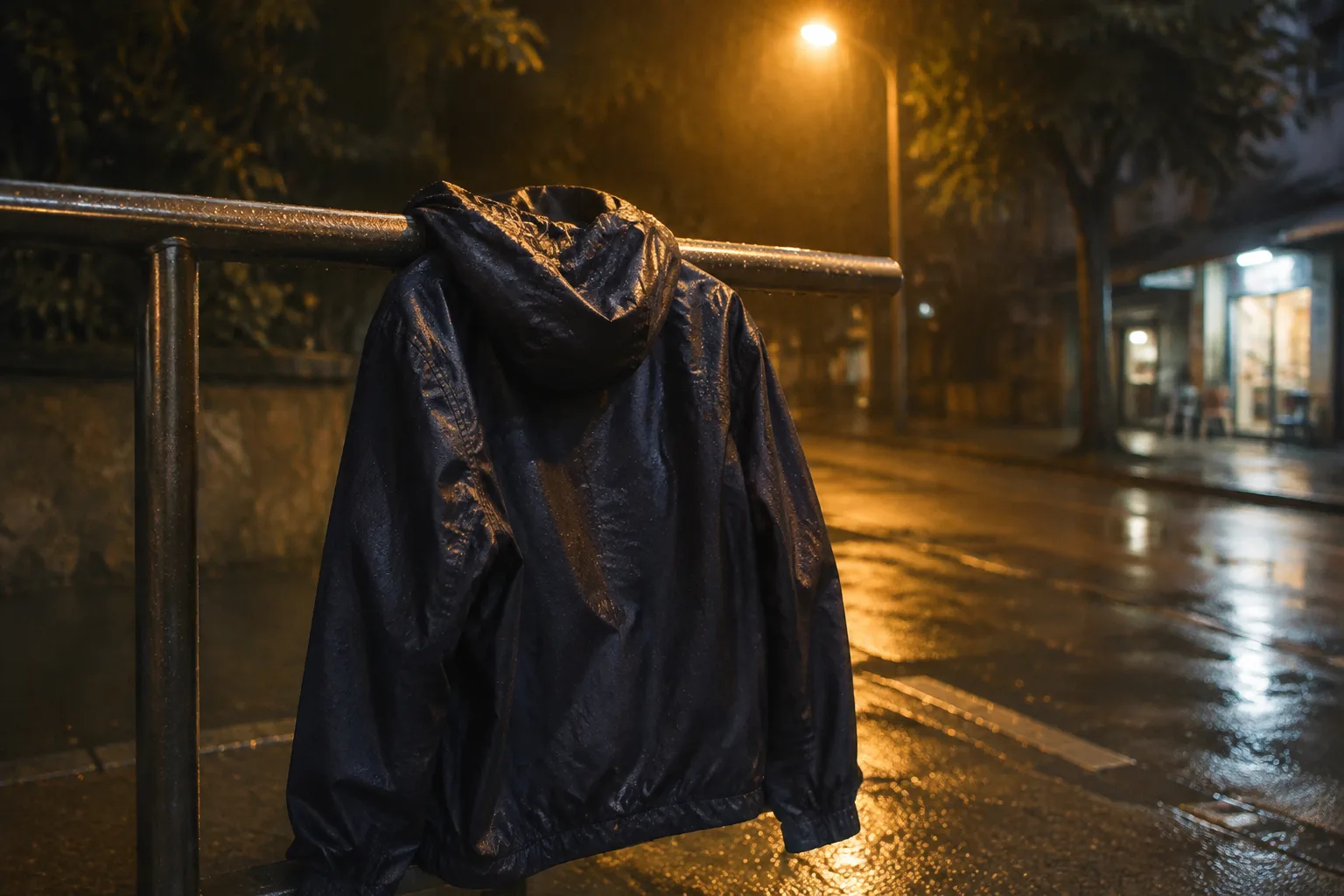
A windbreaker at midnight is a different garment than a windbreaker at noon. Under a streetlight, the nylon takes on a low sheen, almost wet-looking, and the hood bunches at the back of the neck in a way that reads less like sport and more like shelter. The same jacket that looks brisk and athletic on a morning walk turns anonymous after dark, and that anonymity is the whole point.
Most people buy a windbreaker for the weather it keeps off during daylight: the drizzle, the gust, the damp commute. What they actually own is a layer that performs a second job entirely once the sun is gone, one that has little to do with rain.
What nylon does to a streetlight
The fabric is the whole story. A good windbreaker is a thin shell, usually a tight-weave synthetic, often a ripstop grid visible only up close. It does not insulate. It does not breathe much. What it does is stop moving air from stripping heat off a body, and it does that so cheaply in weight and bulk that it can be folded into a bag the size of a fist.
Under sodium or LED light, that tight weave catches reflections along every crease. The jacket stops reading as cloth and starts reading as surface. A person walking a dog at eleven at night in one of these becomes a moving highlight, a shape with edges, visible but not identifiable. The face is shadowed by the hood. The build is hidden by the cut. Only the jacket's color and the rhythm of the walk remain.
That is why the windbreaker has become the unofficial uniform of the late errand. The pharmacy run at 10 p.m. The walk to the corner store. The quick exit from a party that has gone long. The jacket covers whatever is underneath with a single unreadable layer, and it does it without the deliberate menace of a hooded sweatshirt pulled up, without the formality of a coat.
The hood as a piece of architecture
Look closely at the hood of a serious windbreaker and the engineering gets specific. It is usually stowable, either zipping into the collar or rolling into a pocket at the back of the neck. It has an elastic or drawcord edge, sometimes a stiffened brim to keep rain off the eyes. When it is down, it sits as a lump behind the head, and that lump has a social function: it says the wearer is prepared for something, even if the something never arrives.
When it is up, the hood does something else. It narrows the field of vision at the sides, which sounds like a drawback and functions as a comfort. A person inside a raised hood is having a smaller, more private experience of the street. The hood muffles sound slightly. It blocks the peripheral glare of headlights. It creates a small room around the face that moves through the city without inviting conversation.
There is a reason so many people who work odd hours, from night-shift nurses to delivery riders to the person walking home from a closing shift, reach for this exact silhouette. The hood is the cheapest privacy screen on the market.
A jacket that hides its own price
Here is a small, satisfying fact about the windbreaker: the expensive ones and the cheap ones look nearly identical after dark. A two-hundred-dollar technical shell and a forty-dollar packable from a discount rack both hang with the same crisp drop from the shoulders and both catch the same streetlight along the same seams. Construction details, the taped seams or the articulated elbows, disappear into shadow.
This is unusual in clothing. Most garments announce their cost. Leather creases in a way that signals age and money. Wool has a hand feel that betrays its grade. Sneakers have silhouettes that anybody can place. The windbreaker, once it is on a body at night, flattens all of that into a single anonymous shell.
It is one of the last genuinely democratic pieces of outerwear. A person wearing one cannot be placed by income, by neighborhood, or by profession, not from across a street. The garment was designed for function, and function does not care about the label sewn inside the collar.
When the temperature drops further than expected
The windbreaker's great weakness shows up in the small hours, when the air gets colder than the forecast promised. The shell blocks wind but offers almost no warmth on its own. Stand still in one on a cold night and the body begins to lose heat through the fabric, because nothing inside the jacket is trapping it.
Watch how people solve this. They layer. A hoodie underneath, or a fleece, or a sweater that was already on before the jacket went over it. The silhouette thickens at the shoulders and the windbreaker starts to look less like a shell and more like armor over a soft core. It is a look that has become its own genre of late-night dress, particularly among people who spend a lot of time outdoors in cities where the weather changes fast.
The layering is visible in the best way. The hood of the sweatshirt pokes out under the hood of the jacket. The hem of the fleece extends below the shell. Sleeves bunch at the wrists. There is a slight awkwardness to it, a sense that the wearer is dressed for contingencies rather than for a photograph, and that awkwardness is the honest part.
The rustle that gives a person away
There is no quiet way to move in a windbreaker. The fabric announces every shift of the arms with a crisp, papery sound, and in a quiet residential street at night that sound carries. A person trying to walk softly in one discovers quickly that the jacket has other plans. The rustle is part of the garment's character, a small betrayal that keeps it from being truly stealthy.
Some people find this irritating. Others find it reassuring, because the sound is also a signal. A pedestrian approaching on a dark sidewalk who can hear the swish of a nylon sleeve knows there is another person nearby, and that knowledge does a lot of quiet social work. The jacket makes its wearer audible before visible, which is a strange kind of courtesy in a city.
The sound also changes with temperature. Cold nylon is stiffer and louder. Warm nylon softens and quiets down. A person who wears the same jacket all year learns to read the season by the noise it makes on the stairs.
Why the pockets matter more at night
A daytime windbreaker is judged by its hood, its fit, its color. A nighttime windbreaker is judged by its pockets. The hands need somewhere to go when the air turns cold and the walk is longer than planned. A jacket with shallow slash pockets forces the wearer to keep moving. A jacket with deep, lined hand pockets lets a person stand still at a bus stop without suffering.
Then there are the internal pockets, the zippered chest pocket, the hidden sleeve pocket. These are the pockets that matter when a person is carrying a phone, a key, a card, and wants none of it visible. The windbreaker's flat profile means anything bulky in a pocket shows as a lump, so the well-designed ones distribute the load: phone in one hand pocket, keys in the other, cards in a zippered chest slot that sits flat against the sternum.
There is a small pleasure in patting down a windbreaker at the end of a night and finding everything still there, dry and accounted for, while the outside of the jacket beads with moisture that never made it through.
The morning-after problem
The windbreaker has one unglamorous habit that every owner knows. It does not air out well. The synthetic shell traps odor against the body, and a jacket worn on a sweaty walk and then hung in a closet will smell faintly of its wearer by the next evening. Washing helps, but frequent washing degrades the water-repellent finish, so the garment sits in a frustrating middle: too dirty to wear fresh, too delicate to wash often.
The practical solution most people land on is rotation. Two windbreakers, worn on alternate nights, hung to air between uses. It sounds excessive until a person has spent a week in one and noticed the collar starting to hold a smell. The jacket that looked so anonymous on the street turns out to have a very specific relationship with the body inside it.
There is also the matter of the hood. It sits against the back of the neck, gathers moisture from hair and skin, and dries slowly. A person who pulls the hood up every night for a week will find the inner lining damp by Friday. Turning the hood inside out to dry is the small ritual that separates a jacket that lasts from one that gets retired early.
What the jacket says when nobody is looking
Clothing worn after dark tends to be read differently than clothing worn in daylight, and the windbreaker is the clearest case. In the morning, it says something about the weather and the commute. At night, it says something about the wearer's relationship with the street: that they are out in it, that they are prepared for it, and that they would prefer not to be noticed while doing so.
That preference is not antisocial. It is a small, practical contract with the city. The windbreaker lets a person move through public space with the minimum of friction: no umbrella to wrestle, no coat to carry, no outfit to explain, no face to offer. It is the garment equivalent of a lowered voice.
The jacket gets folded, eventually, and put back in the bag by the door. It will be needed again tomorrow night, for the same short walk, in the same low light, doing the same quiet work of keeping a person warm, dry, and unremarkable until they get home.