
The Tennis Skirt, Reconsidered for the Street
The skirt that Serena Williams wore to the 2018 French Open was black, asymmetric, and cut like a leotard, and the tournament president promptly banned it. The garment in question here is the plain pleated white one, the one sold by the millions at sporting goods stores and worn to brunch by people who have never held a racket. That skirt has been dismissed for years as a costume, something borrowed from Centre Court and worn to a café under false pretenses.
The dismissal is lazy. The tennis skirt, considered honestly as street clothing, solves three problems that most everyday skirts handle badly, and it does so with an efficiency that designers keep rediscovering and pretending they invented.
What the pleats were actually for
The pleats on a tennis skirt are not decorative. They exist to give the legs room to move sideways without the fabric catching, and that sideways room is exactly what a skirt needs to survive a flight of stairs, a bicycle seat, a low car door. A pencil skirt forces a person to negotiate with their own clothing; a pleated skirt just moves.
The fabric matters as much as the cut. Tennis skirts are typically a technical blend with a little stretch and a quick-dry finish, and the result is a garment that resists wrinkles in a way that cotton poplin never will. It can be folded into a bag and shaken out. It can sit through a long dinner and stand up looking the same.
And the inner layer, the built-in shorts or brief that most tennis skirts include, is the quiet engine of the whole thing. It removes the entire category of decision-making that skirts normally demand: no slip to adjust, no careful crossing of legs, no wind forecast to check before leaving the house. The garment arrives pre-solved.
The deliberate ambiguities of the silhouette
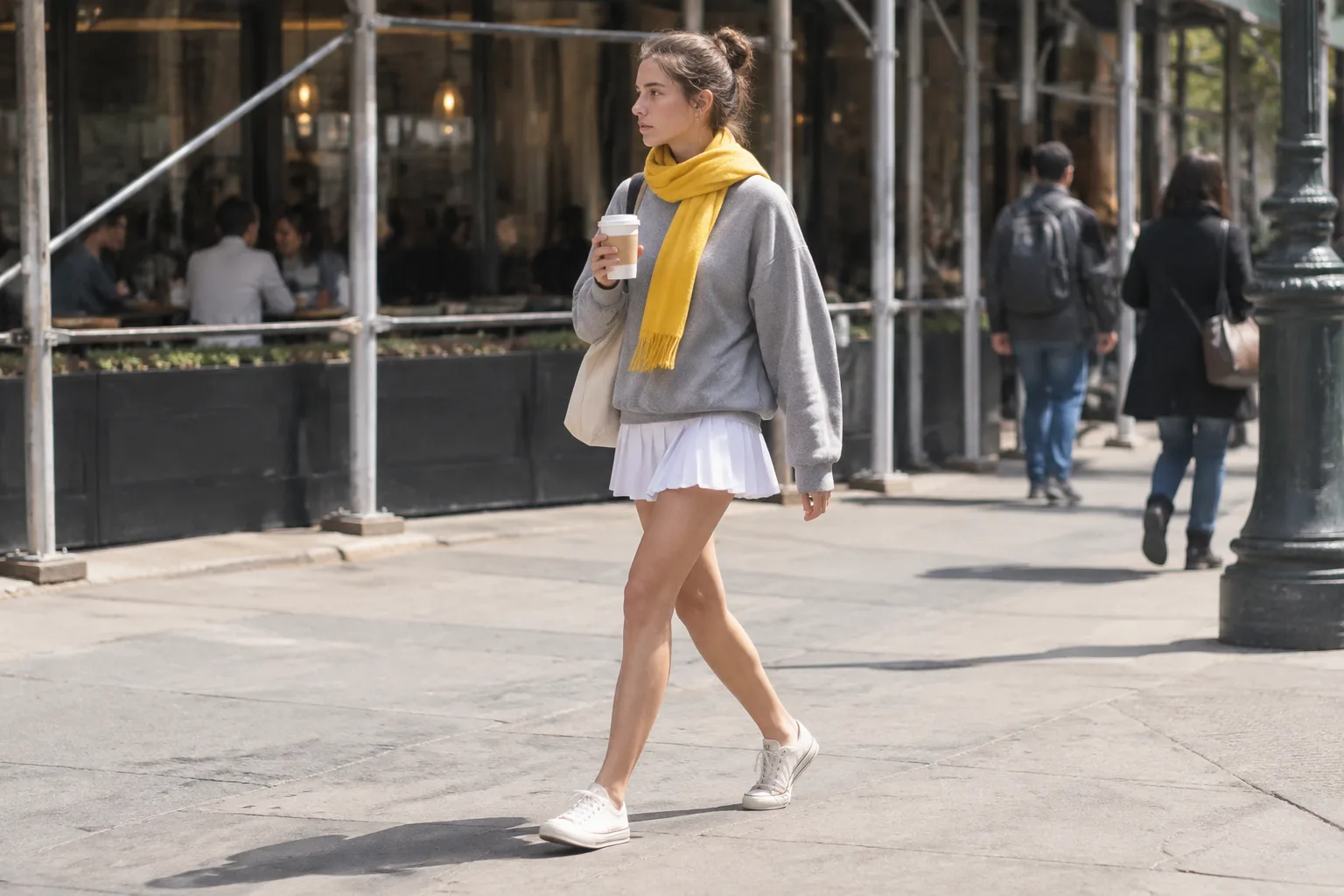
A tennis skirt sits in an odd place on the formality scale. Hemmed short and pleated, it reads as sport. Worn with a sweater and loafers, it reads as something closer to a school uniform, which is a look nobody has ever fully abandoned. With a blazer, it becomes nearly office-appropriate, though this depends heavily on the office.
That ambiguity is the point. The garment does not commit to a context, and so it survives in many. The same skirt can go to a grocery store, a casual Friday, a summer wedding where the dress code is loose, and a weekend away with only one bag. Most clothing demands to know its setting in advance. This one waits to be told.
The waistband deserves a word. Tennis skirts tend to sit flat and high, often with a wide elastic band rather than a zipper, which means they accommodate a long lunch and a seated train ride without the metal hardware that makes some skirts a small act of endurance. The lack of a zipper also removes the single most failure-prone component in a skirt.
The problem of the short hem in real weather
The honest counterargument is that a tennis skirt is a warm-weather garment pretending to be more versatile than it is. Below about fifteen degrees Celsius, a short pleated skirt with bare legs becomes a genuine test of character, and the built-in shorts do nothing to help. The look that works so well in July can look faintly ridiculous in November.
There are fixes, and they are mostly opaque tights, which change the garment's whole register from sporty to something more like a kilt worn to a funeral. Some wearers lean into the contradiction. Others simply accept that the tennis skirt is a seasonal tool, not a year-round one, and put it away with the sandals.
The other real limitation is length. A pleated skirt that hits mid-thigh will ride up when a person sits on a low surface or climbs into a tall vehicle, and the built-in shorts are what save the situation. This is why the inner layer is not optional. A tennis skirt without it is a different, riskier garment, and one that should be assessed before purchase.
Why the white one keeps coming back
White is the traditional color because grass courts and television cameras favored it, and the tradition has outlived the reason. But white also does something practical: it shows the pleats. A dark pleated skirt reads as a single dark shape, while a white one catches the light in the folds and makes the movement visible. The garment looks more alive in white.
The maintenance is the obvious tax. White pleated fabric needs washing after nearly every wear, and it stains at the hem where it meets the world. A person who wants a low-effort garment should choose navy or black and accept the quieter silhouette. The trade is legible: visibility for labor.
The shoe question, settled practically
The single most common styling failure with a street-worn tennis skirt is the shoe. Athletic sneakers make the whole outfit read as a costume, an adult dressed as a tennis player for a day. The skirt does better with something that quietly refuses the sport: a flat leather shoe, a loafer, a simple sandal with a low heel, even a boot in cooler months.
The logic is that the skirt already carries the athletic reference. Adding more sport to it produces caricature. Subtracting sport from it produces tension, and tension is what makes an outfit interesting. A pleated skirt with a plain white shirt and a loafer is a complete thought. The same skirt with a visor and a sweatband is a Halloween costume.
Socks are the small detail that decides which way the outfit falls. Bare ankles push toward summer and ease. A short white sock pushes toward the school-uniform reference, which is either charming or alarming depending on the wearer. A longer sock reads as deliberate styling and needs confidence to carry.
What to check before buying one
The market is flooded with cheap imitations that look right in a photograph and fail in a dressing room. Three things separate a good tennis skirt from a bad one. The first is the shorts: they should be attached, snug enough not to ride, and made of the same quick-dry fabric as the shell.
The second is the pleats. Run a hand along them and check whether they are stitched or heat-set. Stitched pleats hold through washing; cheap pleats that were only pressed will flatten after two cycles and never fully recover. The third is the waistband, which should lie flat and not roll when the wearer bends forward.
Length is the last variable and the one most worth measuring. A skirt that hits at the natural end of the thigh will look tidy on a tall frame and startling on a short one. The hem should be checked while sitting, not just standing, because sitting is where the garment is actually tested.
The case for wearing the thing
There is a school of thought that says clothing borrowed from sport should stay in sport, that the tennis skirt on a city street is an affectation. That view treats clothing as a uniform with rules, and it fails to notice that most of what people wear every day began somewhere specific: the trench coat in the trenches, the bomber jacket on airfields, the polo shirt on horses.
The tennis skirt has already made the crossing. It is sold in ordinary clothing stores, worn to ordinary places, and has been for long enough that the costume objection has lost most of its force. The garment earned its place by being genuinely easy to wear, and ease is a stronger argument than authenticity.
A person who wants a skirt that moves, that resists wrinkles, that requires no advance planning about wind or seating or slips, has a limited set of options. The tennis skirt is one of them, and it is cheaper than most of the alternatives. The white pleated version, hanging in a sporting goods store next to rackets, is a better piece of everyday clothing than half the things in a boutique window.
The next time a pleated white skirt appears on a sale rack in late August, the reasonable move is to try it on with a loafer and a plain shirt, sit down in the dressing room, and see whether the hem behaves. If it does, buy it. The racket is not required.