
The Tennis Skirt, Carried Into Cooler Months
The tennis skirt has a seasonal reputation problem. It belongs, in the popular imagination, to a very particular afternoon: a hard court in July, the white lines shimmering, a can of balls sweating in the shade. Come October, it gets folded into a drawer and forgotten until the first warm Saturday of spring. This is a waste. The garment that comes out of that drawer is one of the more useful pieces in a cold-weather wardrobe, and the reasons have almost nothing to do with tennis.
What makes the tennis skirt work in cooler months is structural. It is short, which sounds like a liability until it is layered. It has built-in volume, which creates a silhouette that holds its shape under a coat. And it is almost always made of a fabric that tolerates weather: nylon, polyester, a cotton blend with some give. These are not delicate clothes. They were designed to be sweated in and washed hard, which means they handle a drizzle and a cold wind better than a wool midi that has to be dry-cleaned.
The skirt that was never really about tennis
The pleated skirt arrived in tennis through a practical detour. Early players wore long dresses, then shorter ones, and the pleats came in because they allowed a stride without binding. By the 1920s the silhouette had shortened dramatically, and by the middle of the century it had settled into something close to what hangs on racks today. The pleats were always about movement, not decoration. That is the detail worth holding onto. A garment built to let a body move freely is a garment that layers well, because it does not fight the body underneath it.
The current version, the one sold in athletic shops and copied by fashion labels, tends to have an inner short or brief sewn in. This is the feature that makes cold-weather wear plausible. The inner layer provides coverage and a bit of warmth at the hip, and it means the skirt can be worn over tights or leggings without any awkwardness. A person can pull on a base layer, add the skirt, and the whole thing reads as intentional.
Tights, and the question of the visible seam
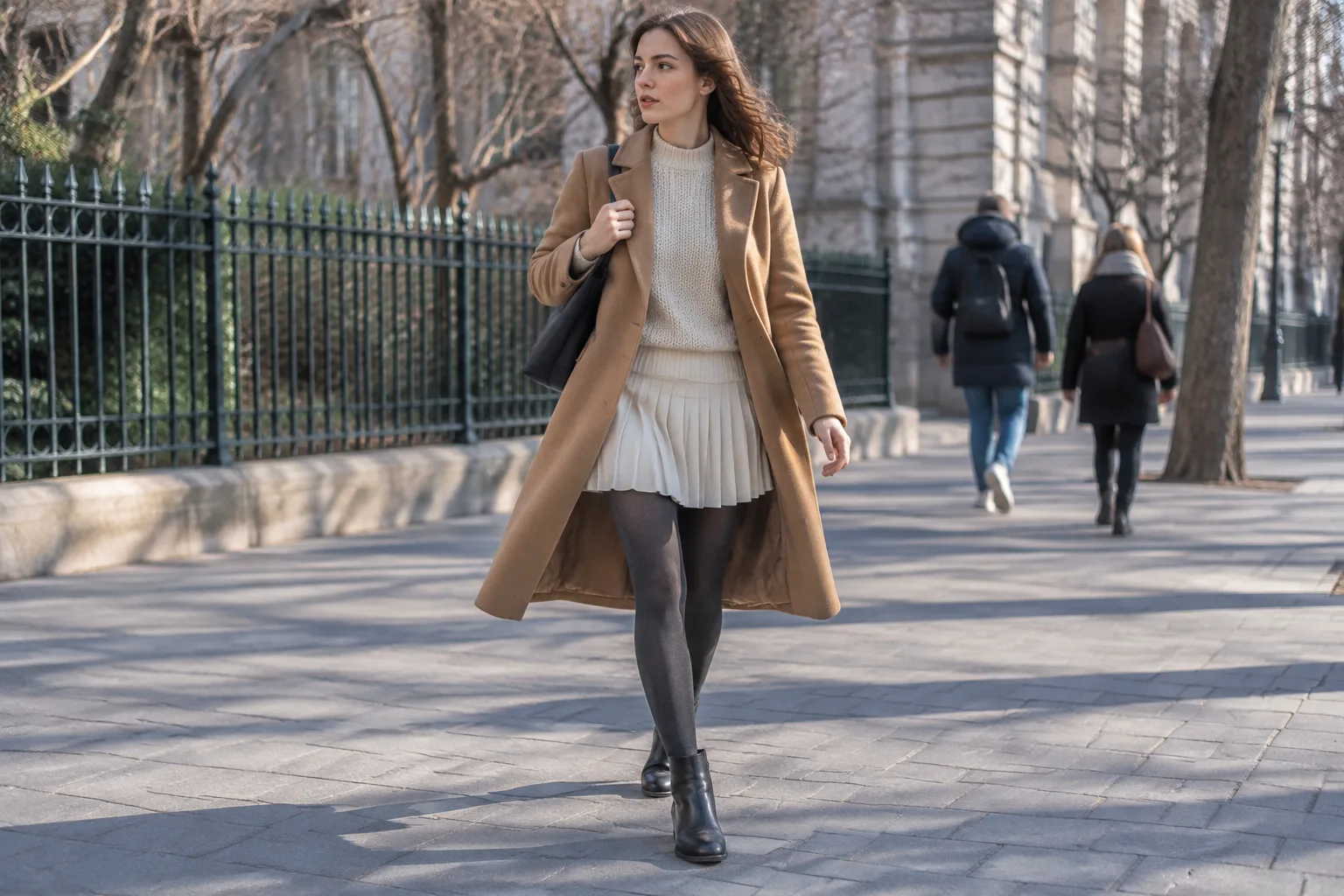
The most direct cold-weather move is the opaque tight. A black or charcoal tight under a white pleated skirt is a clean, almost graphic combination, and it has the advantage of being forgiving: the tight smooths the line of the leg, the skirt adds volume at the hip, and the proportion lands somewhere between sporty and sharp. The pitfall is the waistband. Many tennis skirts sit low, and a high-waisted tight will show a seam or a band of elastic right at the point where the skirt's waistband meets it. The fix is simple and unglamorous: choose a tight with a low or mid rise, or choose a skirt with a higher waist so the two bands overlap cleanly rather than stack.
There is also the matter of the tight's finish. A matte opaque tight reads as clothing. A sheer or shiny tight reads as a costume, and the skirt suddenly looks like it wandered in from a different event. The matte version is the one that works in daylight, on a street, in November.
Leggings underneath, and the length problem
Leggings are the more casual option and the one with more room to go wrong. A full-length legging under a short pleated skirt can look like a runner who forgot her warm-up pants, which is fine if the goal is a Saturday morning errand and less fine if the goal is anything else. The proportion improves when the legging is cropped at the calf or the ankle, so there is a visible gap of skin or sock between the legging hem and the shoe. That gap does a lot of work. It breaks up the vertical line and keeps the outfit from reading as one continuous tube of fabric.
A darker legging under a lighter skirt is the safer pairing. A lighter legging under a darker skirt draws the eye down and can make the legs look shorter than they are. This is not a rule anyone has to obey, but it is the kind of thing that becomes obvious in a photograph and mysterious in a mirror.
The coat that makes the whole thing cohere
A tennis skirt on its own in cold weather is a summer garment in denial. What rescues it is the layer on top. A long wool coat, falling to the knee or below, over a pleated skirt and opaque tights is a combination that has been quietly circulating for years and still looks deliberate. The coat provides the warmth and the seriousness; the skirt provides the movement and the contrast. The eye reads the pleats peeking out below the coat hem as a small, intentional detail.
A cropped puffer or a boxy jacket is the other direction, and it works for a different reason. The short outer layer keeps the volume of the skirt visible and puts the whole silhouette in balance: short on top, short in the middle, long in the leg. A hip-length coat is the awkward middle ground, because it covers the skirt almost entirely and leaves just a hem of pleats showing, which can look like an accident rather than a choice.
Socks, shoes, and the cold-ankle question
The ankle is where cold-weather tennis skirt outfits are won or lost. A bare ankle in December is a statement, and not always a comfortable one. The practical answer is a crew sock or a knee-high sock, and the fashion answer is the same. A ribbed crew sock in cream or charcoal, pulled up over the tight, adds warmth and gives the outfit a prep-school finish that suits the pleats. A knee-high sock under a short skirt is a stronger look, more stylized, and it needs a shoe with some weight to balance it.
On footwear: a chunky sneaker is the easy pairing and the one that keeps the outfit in athletic territory. A loafer or a mary jane pushes it toward something more polished, and that works with tights and a wool coat. A tall boot is trickier, because the skirt is short and the boot is tall and the leg between them is a narrow strip that has to be handled carefully. A boot that comes to mid-calf, with the skirt hem falling just above it, is the version that reads cleanly.
The fabric question, and why nylon beats wool here
Most tennis skirts are synthetic, and in cold weather that is an advantage. Nylon and polyester shed light rain, dry quickly, and do not absorb moisture the way cotton does. A wool skirt in a drizzle becomes heavy and clammy; a nylon skirt shakes off and keeps its pleats. The trade-off is that synthetics do not insulate on their own, which is why the tights and the coat carry the warmth. The skirt is the shell, not the blanket.
The pleats themselves matter for cold weather. A knife-pleated skirt holds its shape and creates air pockets between the folds, which is a small but real buffer against wind. A flat-front skirt has no such structure. The pleats also mean the skirt does not cling, which matters when there are layers underneath and the body is moving through a cold morning.
When the skirt should stay in the drawer
There is a limit. A tennis skirt in a hard rain, with wind, at a temperature near freezing, is a losing proposition no matter how many layers go underneath. The garment is short by design, and short garments expose the thigh, and exposed skin in cold wind is cold. The outfit works in the 40s and 50s Fahrenheit, in dry or lightly damp conditions, on days when a person is moving rather than standing still. A commute, a walk, a market run: these are the settings where it earns its place. A long outdoor event in January is not.
The other limit is the occasion. A pleated skirt and tights is a casual outfit, and it stays casual no matter how good the coat is. It is not office wear in most offices, and it is not evening wear. It is the outfit for the in-between hours, the ones that make up most of a real week.
The white skirt in a gray season
The default tennis skirt is white, and white in autumn and winter is a small act of defiance that pays off. Against a landscape of brown and gray, a white pleated skirt with black tights and a dark coat is a clean, almost architectural combination. The risk is the slush. A white skirt near a wet curb is a white skirt with a gray hem by the end of the day. The practical answer is a skirt in a slightly off-white or a cream, which hides the road spray better, or a colored version in navy, forest green, or a deep burgundy that suits the season without pretending it is still July.
The colored skirt is the more interesting choice. A navy pleated skirt with charcoal tights and a camel coat is a combination that looks like it was assembled by someone with a plan. It also solves the slush problem entirely, which is not nothing on a February morning.
A skirt that earns its keep past the season
The tennis skirt survives the cold months because it was built for movement, and movement is what a layered outfit needs. The pleats swing rather than cling. The synthetic fabric handles weather. The short length turns the tights and the coat into the main event, and the skirt becomes the piece that gives the outfit its shape and its small bit of lift. On a cold, dry Saturday, with a wool coat over a navy pleated skirt and a pair of charcoal tights, the drawer opens and the skirt comes out, and the afternoon is a little better for it.