

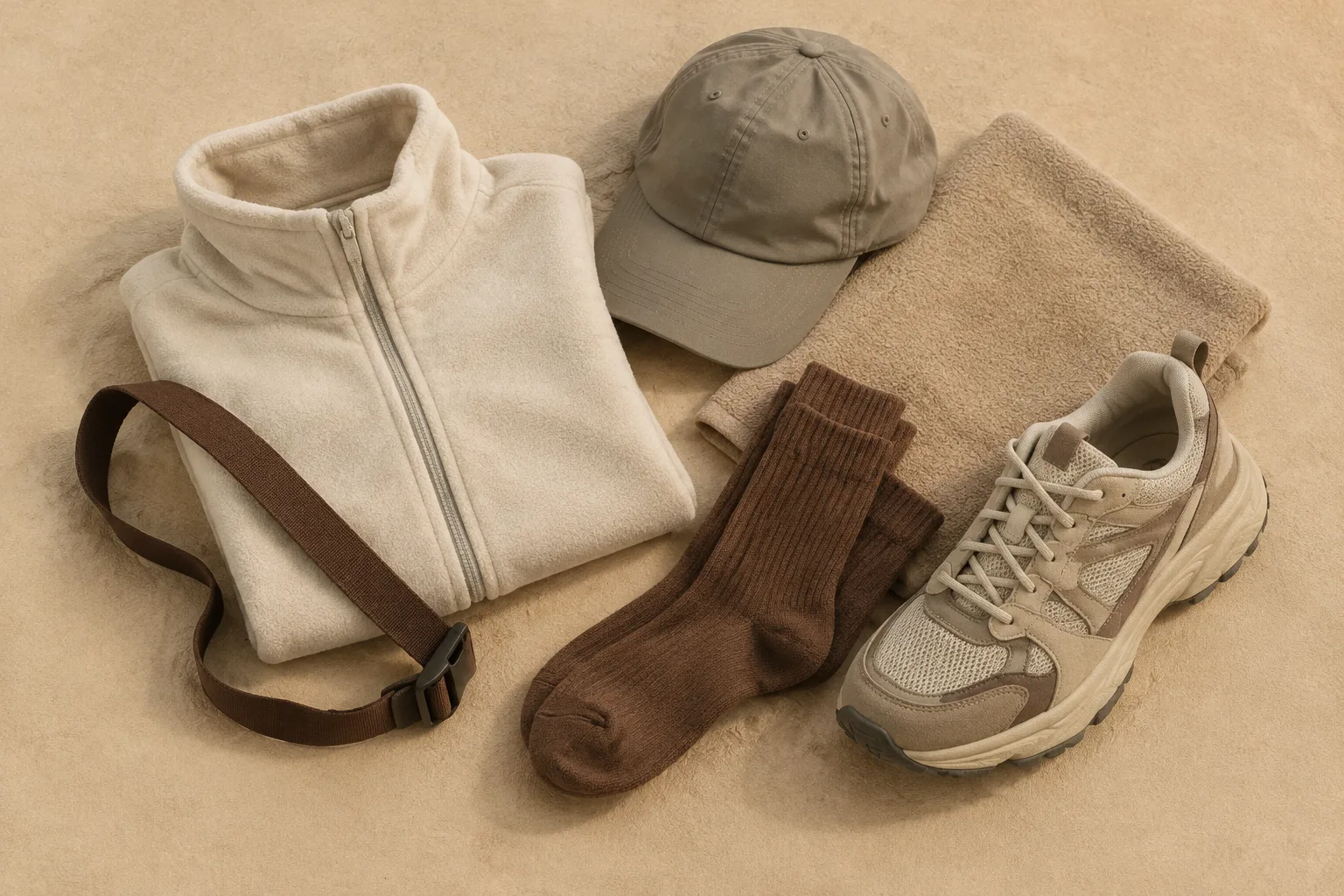
The Neutrals That Carry a Sporty Capsule
Stone, sand, bone, bark. The capsule wardrobe's most useful colors are the ones that look like they were scraped off a beach at low tide, and yet the capsule in question here is not a quiet one. It is a sporty capsule: pieces built for motion, for weather, for the walk to the train and the walk back in the rain. Neutral tones are what keep that kind of wardrobe from turning into a pile of identical gray hoodies, provided the person buying them understands that "neutral" in a sporty context is a much narrower and more demanding category than the word suggests.
The palette in question is not beige, cream, ivory, and taupe in the decorative sense. Sporty neutrals have to survive sweat, abrasion, and repeated washing, and they have to sit next to technical fabrics without looking like a mistake. That rules out a great many of the soft, warm neutrals that photograph beautifully on a linen shirt and go gray and sad after a season of actual use.
What Counts as a Sporty Neutral
The working set is small: black, charcoal, a cool mid-gray, navy, olive drab, and a warm off-white that leans toward bone rather than cream. Add a single tan or clay tone if the wearer has the skin tone and the patience for it. Six colors, maybe seven.
Everything on that list has a job. Black absorbs the visual noise of seams, zippers, and reflective trim. Charcoal reads softer than black under daylight and hides the sheen that technical nylon develops after a dozen washes. Navy is the only dark neutral that looks correct next to denim and next to a suit trouser, which matters for a capsule that has to cross from a run to a desk. Olive drab is the one that makes the whole thing feel like it belongs outdoors rather than in a gym.
The off-white is the risky one, and it is also the one that keeps the capsule from looking like a uniform. Bone, not cream. Cream goes yellow at the collar. Bone stays bone, more or less, if the fabric is a tight knit or a coated shell rather than a loose cotton jersey.
The Gray That Ruins Everything
Mid-gray is the most common mistake in a sporty capsule, and the mistake is usually one of temperature. A warm, heathery gray, the kind that shows up on cheap sweatshirts, turns muddy when paired with black nylon and looks washed out next to olive. A cool gray, closer to slate, holds its own against black and navy and reads as deliberate.
The test is simple enough to run in a store: hold the gray garment against a black technical jacket. If the gray goes pink or green in comparison, it is the wrong gray. If it goes slightly blue, it is the right one. This is the sort of thing that sounds fussy until a person has spent money on a gray layer that only works with two other items in the closet.
Heather gray has its place, and that place is a single sweatshirt worn at home. It does not belong in a capsule designed to be mixed.
Fabric Changes the Color
The same nominal color behaves differently across the fabrics a sporty capsule actually contains. Black merino has a soft, almost matte surface and picks up lint from everything. Black nylon is slick and reflects light in a way that makes it look cheaper than it is unless the weave is dense. Black cotton jersey fades to a charcoal-brown after enough hot washes, which is why the care label matters as much as the swatch.
Olive is the reverse case. On a cotton twill it reads as workwear, honest and slightly dusty. On a technical shell it reads as military surplus, which some wearers want and others find costumey. The solution is to keep olive to one or two pieces and let black and charcoal carry the outer layers.
Navy is the most fabric-sensitive of the group. Navy wool looks expensive. Navy polyester looks like an airline uniform. A capsule that includes navy should spend its money there.
Why Off-White Belongs Anyway
A capsule of black, charcoal, gray, navy, and olive is technically complete and emotionally flat. Off-white is what gives the eye somewhere to rest. A bone-colored tee under a charcoal shell, a bone sock against a black trainer, a bone cap on a rainy commute: these small breaks are what separate a considered wardrobe from a drawer of dark clothes.
The trick with off-white in sportswear is to buy it in fabrics that do not hold stains. A tight mercerized cotton, a nylon blend, a merino with a bit of synthetic in it. Loose slub cotton in bone is a trap; it will look like a rag by August.
The Ratio That Keeps It Sporty
A sporty capsule built on neutrals needs a rough proportion, or it collapses into either a funeral or a hiking catalog. The working ratio, in the experience of people who actually build these wardrobes, is roughly half dark (black and charcoal), a quarter mid (gray and navy), and a quarter earth (olive and bone).
That ratio holds the look together across seasons. In summer the earth quarter grows, because bone and olive handle heat better than black does visually. In winter the dark half grows, because black and charcoal absorb the slush and salt of a real commute.
The ratio also dictates what to buy first. Dark pieces are the spine: a black shell, a charcoal mid-layer, black trousers or tights. Mid and earth pieces are the accents, and accents should be bought last, once the spine is in place.
Where the Capsule Breaks Down
The failure mode with neutral sporty capsules is not color coordination. It is finish. A black shell with a matte zipper, a black shell with a bright silver zipper, and a black shell with a tonal zipper are three different garments, and only one of them belongs in the capsule. Mixing hardware finishes is what makes a neutral wardrobe look assembled rather than chosen.
The second failure is logo discipline. A neutral capsule with three visible brand marks in three different colors is no longer neutral. The rule that works: no more than one visible logo across the whole outfit, and it should be tonal.
The third is the sock and shoe problem, which is where most people quietly give up. Black shoes, black socks, black trousers is the safe line. Bone socks with black shoes is the interesting one, and it only works if the bone in the sock matches the bone in the shirt collar. Get that match wrong and the outfit looks like a mistake that has been repeated on purpose.
A Small Test Before Buying
Before any neutral piece joins a sporty capsule, it should pass a five-item test. Lay it next to a black shell, a charcoal trouser, a navy knit, an olive layer, and a bone tee. If it looks at home next to at least four of the five, it belongs. If it only works with the black, it is a statement piece pretending to be a neutral, and it will sit unworn.
The test takes about ninety seconds on a bedroom floor and saves a season of regret. Most of the gray garments that fail do so against the olive and the bone, which are the two colors that expose warm and muddy undertones fastest.
The Olive Jacket and the Bone Cap
The piece that does the most work in a sporty neutral capsule is almost always an olive outer layer, and the piece that does the second most is a bone cap or beanie. The olive jacket is the one that signals the wardrobe is for outside, not just for the gym mirror. It takes a black base layer, a gray mid-layer, and a navy trouser without complaint, and it gives the whole outfit a place to be.
The bone cap is the opposite kind of piece: small, cheap, and disproportionately effective. It breaks the dark mass at the top of the silhouette, and it does more to make a neutral outfit look intentional than a third gray layer ever will.
Buy the olive jacket in a dense cotton or a bonded shell, not a softshell that pills. Buy the bone cap in a tight knit that can be washed without losing shape. Together they cost less than a single designer accessory and they carry the capsule through a full year of weather. That is the whole case for neutrals in a sporty wardrobe: not that they are safe, but that the right six of them are the only colors that can be worn hard, washed often, and still look like a decision rather than a default.