

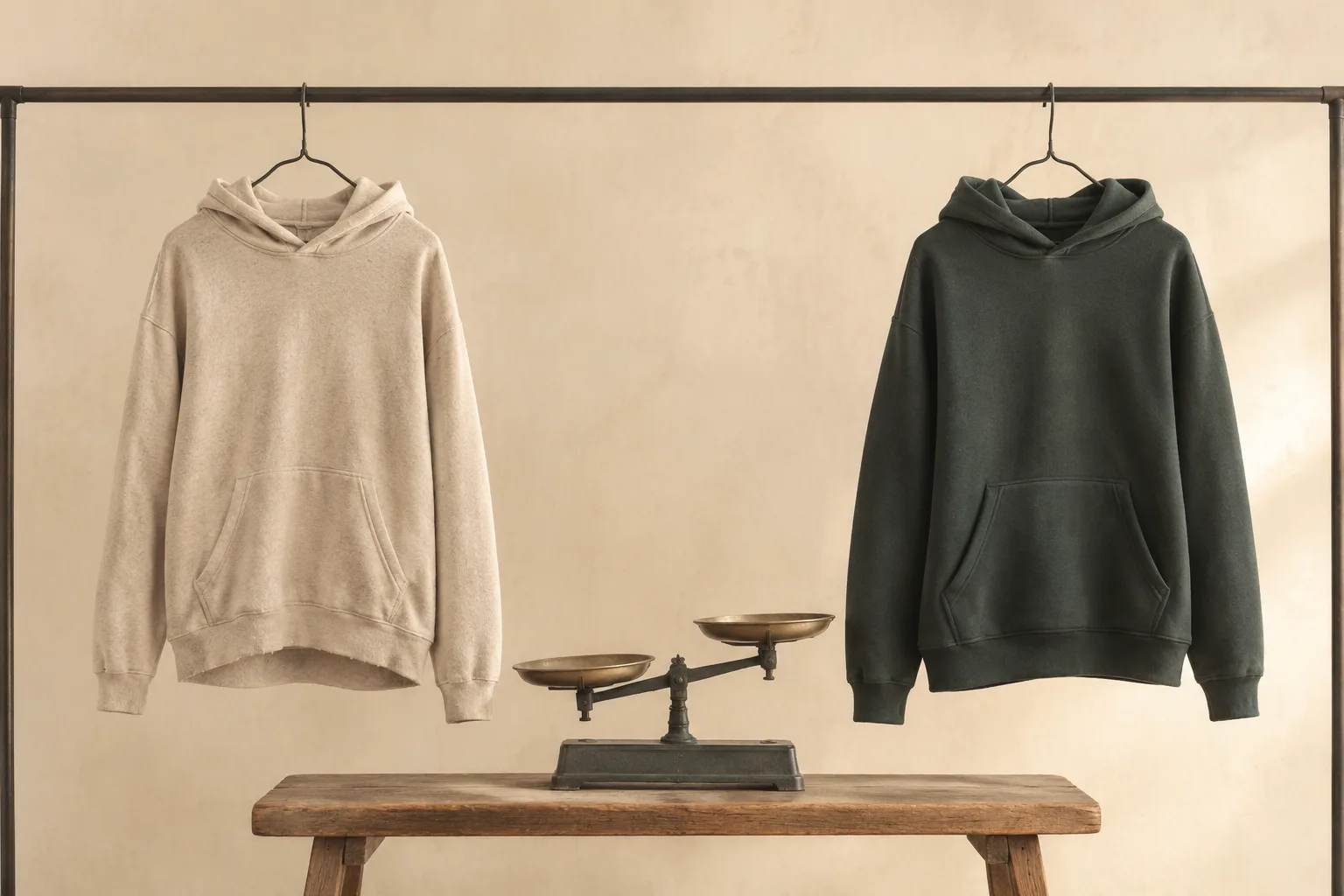
The Honest Price of a Hoodie Worth Keeping
Forty dollars buys a hoodie. Eighty dollars buys a better hoodie. That arithmetic feels obvious until the eighth month, when the forty-dollar one has pilled under the arms, lost its shape at the cuffs, and started to smell faintly of the inside of a gym bag no matter how often it is washed. The eighty-dollar one is still hanging there, darker, denser, doing the same job it did on the first cold morning. The price difference was never really forty dollars. It was forty dollars plus the replacement cost plus the quiet irritation of owning something that never quite worked.
Most hoodies are made to be bought, not kept. This is the central fact of the garment and the reason so many of them fail. A sweatshirt is cheap to produce, easy to ship, and easy to sell on a shelf where it looks nearly identical to a version costing three times as much. The differences live in the fibers, the stitching, and the small decisions made at a factory that the buyer never sees.
A hoodie worth keeping justifies its price through the places where cheapness hides.
The Fleece That Survives the Eighth Wash
Start with the fabric, because everything else is secondary. A cotton hoodie has two sides: a smooth outer face and an inner looped pile, the fleece that gives the garment its warmth and its hand. Cheap fleece is made from short cotton fibers, often blended with polyester to keep the cost down and the surface smooth. Short fibers slip out of the loop structure with wear and abrasion, which is why a cheap hoodie pills at the cuffs and under the arms within weeks.
Better fleece uses longer staple cotton. The loops hold together. The surface stays clean longer. A heavy French terry or a dense brushed-back fleece at 400 grams per square meter feels substantial in the hand, the way a good towel feels substantial, and it holds its shape through a wash cycle without turning into a limp rag.
The weight is the tell. Pick up a hoodie on a rack and let it hang from one hand. If it swings like a T-shirt, it will behave like a T-shirt in a year. A 300-gram fleece is a different object from a 450-gram fleece, and the difference is legible before the first wear. It costs more to make because it uses more cotton and takes longer to knit. That cost has to land somewhere.
Why a Fifty-Dollar Hoodie Costs Fifty Dollars
The retail price of a hoodie breaks into a few broad buckets: fabric, labor, overhead, and margin. On a fifty-dollar hoodie, the fabric is often a cotton-poly blend at a light weight, the construction is simple, and the margin is thin enough that the brand relies on volume. There is no room in that equation for long-staple cotton, reinforced seams, or a double-layer hood.
A hoodie at one hundred and fifty dollars can afford all three. It can use a heavier fleece, pay for a factory that sews at a slower rate, and still leave the brand enough margin to stay in business. The price is not a markup on vanity. It is the honest cost of the materials and the labor that produce a garment capable of lasting a decade.
The trouble is that the middle of the market has thinned out. The fifty-dollar hoodie and the two-hundred-dollar hoodie are easy to find. The ninety-dollar hoodie, made well but without a logo, is harder. Brands have learned that shoppers compare prices on the shelf, not after three years of wear, so the incentive runs toward cutting the things that only show up later.
The Seams, the Cuffs, and the Hood Itself
Construction is where the honest price becomes visible. Turn a hoodie inside out and look at the side seams. A cheap one uses an overlock stitch that leaves a raw edge and a loose thread trail. A good one uses a flatlock or a coverstitch that joins the panels cleanly and lies flat against the body. The difference shows up in how the garment drapes and how long it survives a washing machine.
The cuffs and hem are the first parts to fail. Ribbing has to be dense and elastic, and it has to be sewn with a stitch that can stretch. Cheap ribbing goes slack after a season and the cuff starts to gape. The same logic applies to the hood. A single-layer hood is a flap of fabric. A double-layer hood holds its shape, sits up on the head, and does not collapse into a sad triangle after a few wears.
Then there is the drawcord. A flat cotton cord with metal aglets is a small detail that costs almost nothing to add and almost nothing to skip. It is the kind of thing a manufacturer cuts first when a buyer asks for a lower price. Its presence on a hoodie is a signal, not a guarantee, that the rest of the garment was made with similar care.
The Hidden Tax of Replacing It Every Two Years
Here is the accounting that makes the honest price feel less like a splurge. A fifty-dollar hoodie replaced every two years costs twenty-five dollars a year across a decade. A one-hundred-and-fifty-dollar hoodie worn for ten years costs fifteen dollars a year. The cheaper garment is more expensive to own, and the math holds even before the time spent shopping, the returns, and the small annoyance of a hoodie that never fit right.
The replacement cost is only part of it. A cheap hoodie that pills and fades gets pushed to the back of the drawer and eventually into a donation bin. Textile waste is a real problem, and the hoodie that was designed to be discarded is a small but steady contributor. Buying one good garment instead of five mediocre ones is a modest act, but the aggregate matters.
There is a social cost too, though it is harder to put a number on. A person who owns three hoodies they actually like reaches for them without thinking. A person who owns twelve they tolerate spends a small amount of attention every morning deciding which one is least bad. That is a real expense, paid in a currency nobody budgets for.
Where a Higher Price Stops Paying for Itself
The honest price has a ceiling. Above a certain point, the extra money buys branding, scarcity, and the kind of design that is meant to be photographed rather than worn. A four-hundred-dollar hoodie from a luxury house is not four times better than a one-hundred-and-fifty-dollar hoodie from a maker that specializes in fleece. It is a different product with a different job.
The signal to watch is whether the price maps to something a person can verify. Heavier fabric, denser ribbing, flatlock seams, a double-layer hood, a drawcord with aglets: these are legible. A price that rests on a logo, a collaboration, or a story about a designer's childhood is not paying for the garment. It is paying for the association.
A hoodie worth keeping tends to sit in a narrow band: expensive enough to use real materials and slow construction, not so expensive that the buyer is subsidizing a marketing budget. Finding that band takes a little work, and the work is mostly reading labels and turning garments inside out.
A Hoodie That Outlives the Trend That Sold It
The last thing the honest price buys is time. A well-made hoodie in a plain color, with a fit that is neither aggressively oversized nor cut like a compression layer, stays wearable through the cycles of fashion that would otherwise retire it. The gray raglan sleeve sweatshirt has been in production for most of a century because it works. The hoodie that copies that logic, in a heavy fleece with a clean silhouette, will still be in rotation when the trend that introduced it has been forgotten.
That longevity has a practical consequence. A hoodie that lasts a decade becomes part of a person's uniform. It gets a name in the household, a hook by the door, a specific smell of laundry soap and cold air. It is worn to the hardware store and to the airport and to the emergency room at two in the morning. The cost per wear drops so low that the original price stops being a number anyone remembers.
The garment that survives is the one that was made to survive. A cotton fleece at 450 grams, sewn with flatlock seams and a double-layer hood, will outlast a lighter one by years. The honest price is the amount that buys those years, nothing more and nothing less. A shopper who understands that can walk into a store, turn a hoodie inside out, and know within a minute whether the price on the tag is telling the truth.