
Shelving and Storage: Keeping a Sneaker Collection Intact
A sneaker collection can survive a decade of wear and still fall apart in a closet. The leather cracks along a crease that never got a chance to breathe, the midsole yellows in a slow gradient, and a pair that cost more than a week's groceries comes out of the box with a smell that will not leave. None of that damage happens on a foot. It happens in storage, in the dark, over months, while the owner assumes the shoes are safe.
The shelving decision sits at the center of this. A collection kept intact has almost nothing to do with how many pairs a person owns and almost everything to do with how those pairs are held, what touches them, and what the air around them does. Storage is where most collections quietly lose value, and it is the one part of collecting that gets the least thought.
The Shape a Shoe Holds When Nothing Holds It
A sneaker is engineered to hold a foot, not empty space. Pull the foot out and the shoe begins to collapse under its own weight: the toe box creases inward, the heel counter softens, the collar folds over. Left flat on a shelf for a year, a high-top can settle into a permanent slouch that no amount of wearing will reverse.
Shelf design has to answer this before anything else. A shoe needs a base that supports the full length of the sole and a back that keeps the heel upright. Shelves that hold only the front half of a shoe, or that let the heel overhang, put pressure on one section and let the rest drift.
This is why flat plank shelving beats wire racking for anything with structure. Wire grid shelves leave the sole resting on a handful of contact points, and over time those points press shallow dents into soft foam. A solid shelf spreads the load. The cost difference between a wire unit and a plywood plank is small; the damage difference is not.
Why the Box Is Not a Storage Plan
The cardboard box a sneaker arrives in feels like the obvious home. It is the right shape, it stacks, and it keeps dust off. The problem is what happens inside that box over a year. Cardboard pulls moisture from the air and holds it against the shoe. Adhesives in the box and in the shoe itself off-gas, and in a closed space those gases concentrate. A pair stored this way for two years can come out smelling of glue and old paper, with a yellowed midsole and a slightly tacky outsole.
Boxes also hide the problem. A collector who stacks twenty boxes in a closet cannot see the slow yellowing, the mold spotting on a toe, or the crease setting in. Damage stays invisible until the box is opened, which is usually too late.
There is a case for keeping the original box, and it has nothing to do with storage. Some pairs hold resale value partly through their packaging, and a pristine box with the right labels adds to that. The fix is to keep the box flat and empty on a high shelf and store the shoe itself somewhere the air can move.
Open Air, Moving Slowly
Airflow is the quiet variable in every storage setup. A pair on an open shelf in a room with normal circulation stays dry. The same pair in a sealed bin, a closed box, or a bag with no vent develops condensation whenever the temperature shifts. Morning warmth and evening cool push moisture in and out of the material, and trapped air cannot release it.
That rules out vacuum bags and sealed plastic tubs for anything meant to be worn again. Both are fine for a move or a short-term transport. For long-term keeping, they turn a closet into a slow oven of humidity.
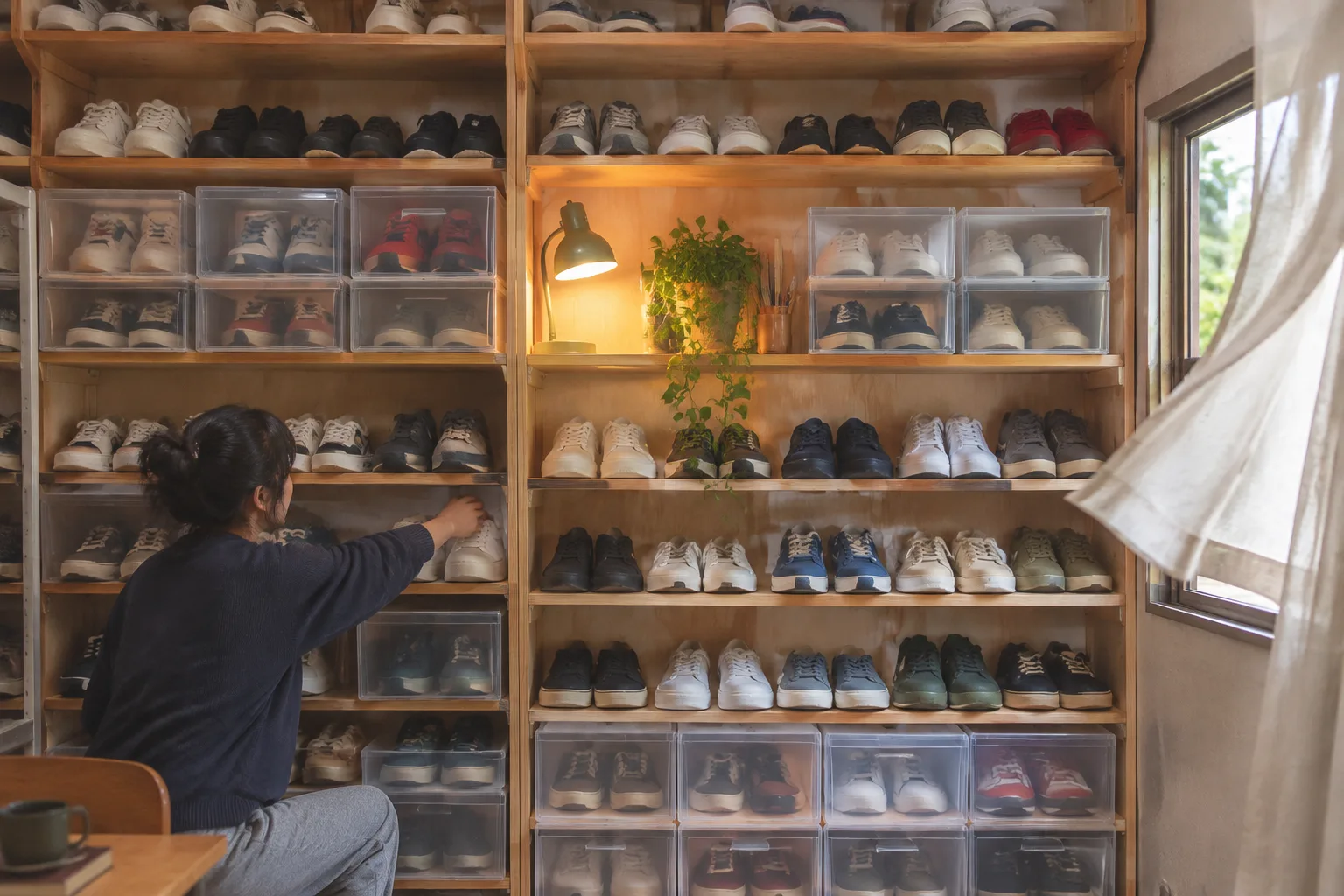
Open shelving with a small gap between pairs does most of the work. A shelf depth of about 12 to 14 inches fits most sneakers with a little room to spare, and spacing pairs a couple of inches apart lets air pass between them. Cramming a shelf tight looks tidy and stores badly.
What Light Does to a White Midsole
Sneaker collectors talk about yellowing as if it were inevitable. It is not. Ultraviolet light accelerates the oxidation that turns a white foam midsole cream, then tan, then a shade close to weak tea. A pair kept in a dark closet yellows far more slowly than the same pair on an open rack by a window.
That creates a real tension with the open-air advice. The best storage is both ventilated and dark. A closet with a door that stays mostly closed, or a shelving unit with a breathable fabric cover, hits both. A glass-front cabinet by a south-facing window fails on light even though it looks like the premium option.
For collections displayed openly in a room, rotation matters. A pair that sits in direct sun for a month will show a visible line where the light hit it. Moving pairs every few weeks spreads the exposure and keeps any single shoe from taking the full dose.
The Weight Problem on Stacked Shelves
Stacking works for boxes of cereal. It works poorly for sneakers. A shoe on the bottom of a stack carries the weight of everything above it, and soft foam midsoles compress under sustained load. A pair that spends eighteen months under three other pairs can come out with a flattened cushion that never fully recovers.
Shelves with a fixed vertical gap of about 8 inches solve this for most low-top sneakers. High-tops need closer to 10 or 11. The point is to build the shelving around the tallest pair in the collection and let the shorter ones have air above them, rather than stacking to save space.
Wall-mounted racks that hold shoes by the heel work for display but put the entire weight of the shoe on the heel counter. Over time that pressure deforms the structure. A heel hook is fine for a week. For a year, it is a slow injury.
Inserts, Paper, and the Small Habits
A shoe tree or a stuffed insert keeps the toe box from collapsing and holds the shape through months of disuse. Cedar shoe trees pull moisture and leave a faint smell that covers the worst of a worn pair. The cheap alternative is crumpled acid-free paper, which does the same job for the toe box without the cost.
Newspaper is the wrong choice. The ink transfers to light-colored linings, and the paper is acidic enough to stain over time. A pair of white canvas sneakers packed with newsprint for a season will come out with gray shadows along the inside.
The small habit that matters most is airing a worn pair before it goes back on the shelf. A shoe worn for a full day holds sweat and warmth. Putting it straight into a closed space traps that moisture against the lining. Twenty minutes on an open rack before shelving extends the life of the interior by years.
Shelving Built for the Collection, Not the Room
Most shelving is designed for books or for display, and sneaker collections have a different set of demands. The unit needs solid planks, a back panel that lets air move, adjustable shelf heights, and a depth that fits the longest shoe without overhang. A retail-style slatwall with wire shelves looks sharp and fails every one of those tests.
A simple built-in of painted plywood, 14 inches deep, with shelf heights set to the tallest high-top and a couple of small ventilation gaps drilled in the back, costs less than a designer rack and outperforms it. The collector who builds for the actual collection, rather than buying a furniture piece that happens to fit shoes, keeps pairs intact for years longer.
There is a quiet satisfaction in opening a closet after two years and finding a pair that looks like it was shelved last week. That outcome does not come from careful wearing. It comes from a shelf that held the shoe the way the shoe was built to be held: upright, supported, dry, and out of the light.