
Room to Move: A Buying Guide for Sneakers That Fit Wider Feet
The shoe box said 10.5. The shoe inside fit like a 9. This happens to wide-footed buyers constantly, and it is the single most expensive frustration in casual footwear: a closet of sneakers that were the right length and the wrong everything else.
Width is the dimension the sneaker industry treats as an afterthought. Most models ship in one width, built on a last that splits the difference between narrow and average. A foot that runs wide at the metatarsals, or carries extra volume through the instep, gets squeezed into a shape designed for somebody else. The resulting shoe is not merely snug. It distorts the fit everywhere: the heel slips because the foot cannot seat far enough forward, the laces gap at the bottom, the toe box pinches the little toe until it goes numb on the walk home.
Buying well for a wide foot is a skill, and it starts with unlearning the size on the tongue.
Why "True to Size" Means Almost Nothing
Length is standardized, roughly. A men's size 10 is about 27 centimeters of last, and brands hew close to that. Width has no such discipline. Two size 10 sneakers from different brands can differ by nearly a centimeter across the ball of the foot, which is the difference between comfortable and unbearable.
Then there is volume: the height of the shoe's interior above the foot. A shoe can be wide at the ball and still crush the top of the instep, which is a separate problem with a separate fix. Reviewers who write "runs narrow" are usually describing one of these two failures without distinguishing them, which is why the advice feels useless.
The practical response is to stop trusting the number and start trusting the last. Brands that publish width options do so because their lasts are cut to accommodate them. Brands that do not are selling a single shape and hoping it lands.
The Brands That Actually Build Wide Widths
New Balance is the reliable answer, and it is reliable for a structural reason: the company has offered multiple widths across its running and lifestyle lines for decades, and its wide sizing (typically 2E and 4E for men) is cut on a genuinely different last rather than a stretched version of the standard. The 990 series in 4E is the closest thing the market has to a default recommendation for a broad foot, and it earns that status through consistency rather than hype.
Saucony and Brooks both run wide programs in their running lines, and both are worth knowing because their wide lasts are athletic rather than casual. A person who needs width for walking and standing all day will find more support in a Brooks wide than in most lifestyle sneakers, even if the styling is louder than a plain court shoe.
Asics offers wide options in select models, mostly in the GT and Gel-Kayano families, though availability varies by region and colorway. Hoka's wide sizing has expanded in recent years and suits high-volume feet well because the brand's base last already runs roomy. On the budget end, Skechers sells wide fits in several casual lines, and while the materials are not built for a decade, the width is real.
What these brands share is not a marketing promise. It is a second set of tooling. That is the distinction worth paying for.
When a Standard Width Is the Right Call
Not every wide foot needs a wide shoe, and buying wide reflexively creates its own problems. A shoe cut too generously lets the foot slide, which produces blisters at the heel and a sloppy, unstable stride. The foot should feel held, not housed.
Some standard-width sneakers run wide by design. Certain skate silhouettes, including classic Vans and Converse models, have boxy toe boxes that accommodate a broader forefoot without any special sizing. Several retro runners, notably the New Balance 574 and the Asics Gel-Lyte line, run roomy through the midfoot. The trick is knowing which specific models run generous, which is community knowledge more than brand knowledge, and it changes with each redesign.
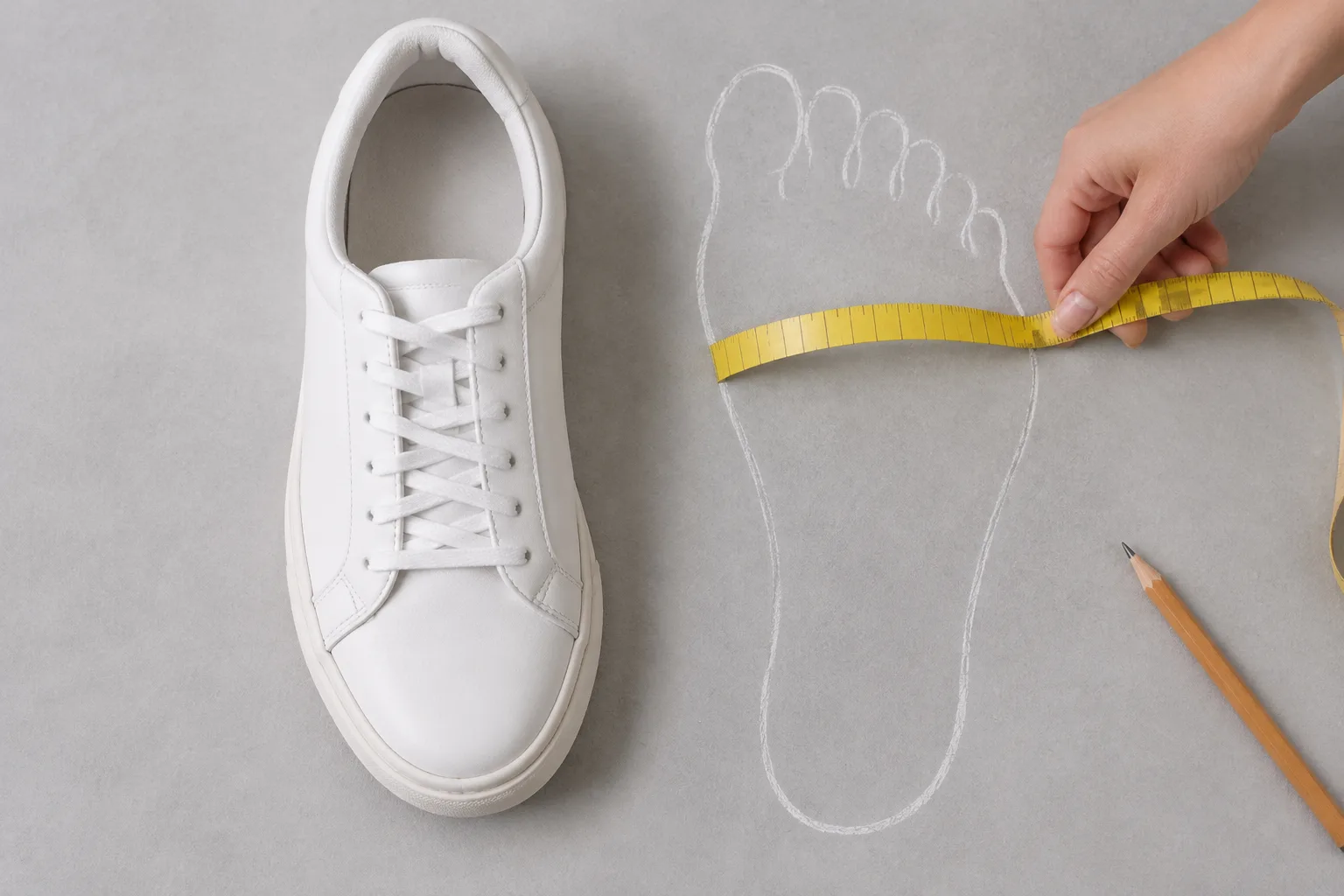
A useful test before ordering: measure the foot at the widest point while standing, since feet spread under body weight. Compare that number to the published last width for the model in question, not to the size chart's generic guidance. If the model's width is not published, assume average and size up cautiously.
The Upper Matters as Much as the Last
Two shoes built on identical lasts can fit differently depending on the upper. Knit uppers stretch and conform, which helps a marginally wide foot but offers no structure for a genuinely broad one. Leather and suede break in and mold over weeks, which is a slow accommodation but a durable one. Engineered mesh sits in between: it gives a little at pressure points without losing shape.
Stitched overlays are the enemy. A decorative seam running across the top of the toe box will press into a high instep with every step. So will a rigid plastic heel counter that sits too far forward. When trying on, the fingers should run along the interior seams before the shoe goes anywhere near a treadmill.
Lacing is the cheapest fix available. A wide foot often sits too high in the shoe, and the standard crisscross pulls the two sides together over the instep, creating pressure. Rerouting the laces to skip the lowest eyelets, or switching to a straight bar lacing pattern, redistributes tension across the foot rather than concentrating it at the center. It costs nothing and rescues shoes that would otherwise be returned.
The Half-Size-Up Myth
The standard advice for a tight shoe is to go up half a size. For width, this is mostly wrong. Length and width scale together on a last, but not proportionally, and a half size adds roughly 4 to 5 millimeters of length while adding a negligible amount of width. The result is a shoe that is too long and still too narrow, which is worse than the original problem because now the heel slips too.
Sizing up works only when the issue is toe contact at the front, a length problem. A wide foot that sizes up to chase width ends up with a shoe that bends in the wrong place, creases across the wrong part of the foot, and wears out faster at the flex point. The correct move is a wider last at the same length, or a different model entirely.
What to Check in the First Ten Minutes
A try-on has a sequence, and skipping steps hides problems that only surface after a mile. Start with the heel: it should sit locked against the back of the shoe with a finger's width of room, no more. A slipping heel means the shoe is too long or the last is too narrow to let the foot seat properly.
Next, press a thumb down across the top of the toe box. There should be about a half-inch of clearance above the longest toe, and the material should give slightly without collapsing. Then walk. The flex point of the shoe should line up with the ball of the foot, not behind it or ahead of it. A shoe that bends in the wrong place will cause arch fatigue within an hour.
Finally, check the width at the ball while standing. The upper should feel snug but not compressive, and the little toe should not be pressed against the sidewall. If the foot spills over the edge of the insole, the shoe is too narrow regardless of what the label says.
Insoles, Inserts, and the Volume Trade-Off
Aftermarket insoles solve some wide-foot problems and create others. A cushioned insole raises the foot inside the shoe, which helps a low-volume fit but steals space from a high instep. A person with both width and volume needs a thin insole or none at all, plus a shoe with a roomier interior height.
Removing the factory insole is a legitimate diagnostic. If the shoe fits well without it, the problem is volume, and the fix is a thinner insert rather than a wider shoe. If the shoe still pinches at the sides, the problem is width, and no insole swap will help.
Orthotic users face a harder constraint: many wide shoes will not accept a rigid orthotic without crowding the toes. The shoe has to be wide enough for the foot plus the insert, which usually means going to the widest available option and accepting a looser fit elsewhere, or choosing a model with a removable footbed and a deep heel cup.
The Cost of Getting It Wrong
A sneaker that pinches does not just feel bad. It changes how a person walks. The stride shortens, weight shifts to the outside of the foot, and the ankle rolls inward to compensate. Over months, that pattern can contribute to knee and hip discomfort, though the precise relationship is general and not something a shoe review can diagnose.
The financial cost is simpler to count. A pair returned for fit is a pair bought twice. A pair worn despite the pinch is a pair abandoned in six months, often with the sides blown out where the foot pushed against the upper. The wide-footed buyer who chooses a proper last pays once and wears the shoe for years, which is why the brands with real width programs justify their prices even when the styling is unglamorous.
The closet full of wrong-size sneakers is not a failure of shopping discipline. It is the predictable result of an industry that treats width as a niche. The buyer who learns to read lasts, ignore the size on the tongue, and test the fit in a sequence will end up with fewer shoes and better ones, and the difference will show in every step taken in them.