

Retro Runners That Earn a Daily Slot
The daily rotation is a brutal filter. Most running shoes, however well reviewed on the day of purchase, end up in a closet pile within a season. The ones that survive are not always the fastest or the most cushioned. They are the ones that make the ordinary Tuesday run feel frictionless, the ones a runner reaches for without thinking.
Retro runners have quietly colonized that slot for a lot of people. Not the hyped collaborations, not the museum pieces, but the plain, decades-old silhouettes that still get made in reasonable quantities and still cost less than a night out. They earn the daily slot because they ask almost nothing of the runner and give back a surprising amount.
What Counts as a Retro Runner
The category is loose enough to be confusing. A retro runner here means a shoe designed for road running sometime between the late 1960s and the early 1990s, still produced in something close to its original form, and still sold as a lifestyle shoe rather than a performance one.
That definition excludes the reissues that have been hollowed out into fashion objects with no running DNA left. It also excludes modern shoes styled to look old. The point is the actual old thing, made with a flat foam midsole, a suede or nylon upper, and a rubber outsole that has not been redesigned to within an inch of its life.
These are shoes that once carried marathoners and now carry commuters, dog walkers, and people who want a running shoe that does not look like a running shoe. The distinction matters, because the shoe that earns a daily slot is rarely the one that wins a race.
The Flat Foam Problem, and Why It Helps
Modern running shoes have spent four decades stacking foam higher and softer. The result is a shoe that feels wonderful for the first mile and vague by the fifth, because a tall, soft midsole asks the foot to stabilize itself on every landing.
Retro runners sit low. A typical vintage-style midsole is somewhere around 20 to 25 mm at the heel, sometimes less, with a modest drop. That geometry lets the ground do more of the work. The foot feels the surface, the ankle adjusts, and the calf and arch engage in a way that a max-cushion shoe quietly discourages.
This is not an argument that flat foam is superior for everyone. Runners with a history of impact-related complaints may find the road comes through too clearly. But for the large middle of the running population, a lower, firmer shoe delivers a kind of feedback that makes easy days feel like training rather than floating.
Five Silhouettes That Keep Getting Worn
The list is short and stubborn. The Adidas Samba and Gazelle family, originally indoor football and training shoes, have become the default casual shoe across much of Europe and now beyond. They are not running shoes in any modern sense, but they descend from the same flat-rubber tradition and they are worn daily by people who walk more than they run.
The Nike Cortez, introduced in the early 1970s, is the purest example of the type: a wedge of firm foam, a leather upper, a herringbone outsole. It has been in continuous production for over fifty years, which is its own kind of review.
The New Balance 574 sits at the more cushioned end, with a slightly higher stack and a wider fit that suits people with broader feet. The Saucony Jazz Original offers a similar low, even ride with a suede-and-mesh upper that has barely changed since the early 1980s. The Puma Suede, another indoor-court shoe, rounds out the group as the most casual of the five.
None of these shoes would be recommended for a marathon. All of them handle a three-mile easy run, a full day on feet, or a week of travel without complaint.
The Break-In Is Real and It Is Short
A new pair of retro runners feels stiff in a way modern shoes do not. The midsole is dense, the upper is often leather or heavy suede, and the first two or three wears can produce a hot spot at the heel or across the top of the foot.
Then something shifts. The foam compresses into the shape of the foot, the leather softens at the flex point, and by the end of the first week the shoe has become specific to its wearer. This is the opposite of the modern experience, where a shoe feels broken in from the first step and then degrades toward mush.
The break-in is a feature. A shoe that molds to the foot holds that shape for years. A shoe that starts soft has nowhere to go but softer.
What the Daily Slot Actually Demands
The daily slot is not a race slot. It is the shoe that gets laced at 6:40 in the morning when the light is grey and the legs are heavy, and again at lunch for a walk, and again on the weekend for errands. It has to be tolerable in all three contexts.
That rules out shoes with aggressive rocker plates, shoes with uppers that need careful sock pairing, and shoes that look so technical they cannot be worn with anything but running kit. Retro runners pass all three tests by default, because they were designed before any of those features existed.
Durability matters too. A flat rubber outsole with a proper herringbone or waffle pattern wears slowly, and many of these shoes can be resoled by a competent cobbler. The leather and suede uppers scuff, but they scuff in a way that reads as patina rather than damage.
Where They Fall Short
Honesty requires naming the limits. Retro runners offer minimal arch support, and anyone with a diagnosed structural issue in the foot or ankle should treat them as a casual shoe at most. The cushioning is thin by modern standards, so long road runs on hard surfaces will leave the legs more beaten up than a plush trainer would.
Wet-weather grip is also modest. The rubber compounds used on these shoes are older formulations, and a smooth outsole on a wet pavement can feel slick. This is a shoe for dry days and mixed surfaces, not for a rainy half marathon.
And the sizing runs narrow on several of the classic silhouettes, particularly the Cortez and the Samba. A wide-footed runner should look at the New Balance 574 first, or size up and accept a little extra length.
The Cost Case Over Three Years
A modern performance trainer retails somewhere between 140 and 200 dollars and is typically retired after 300 to 400 miles. A retro runner costs between 70 and 110 dollars and, because it is worn for walking and easy days rather than hard training, can last two to three years of daily use before the outsole wears through.
The math favors the retro shoe by a wide margin. That is not a reason to buy one, but it is a reason the daily slot keeps going to the same few silhouettes year after year. People notice when a shoe costs less and lasts longer.
The Pair That Ends Up by the Door
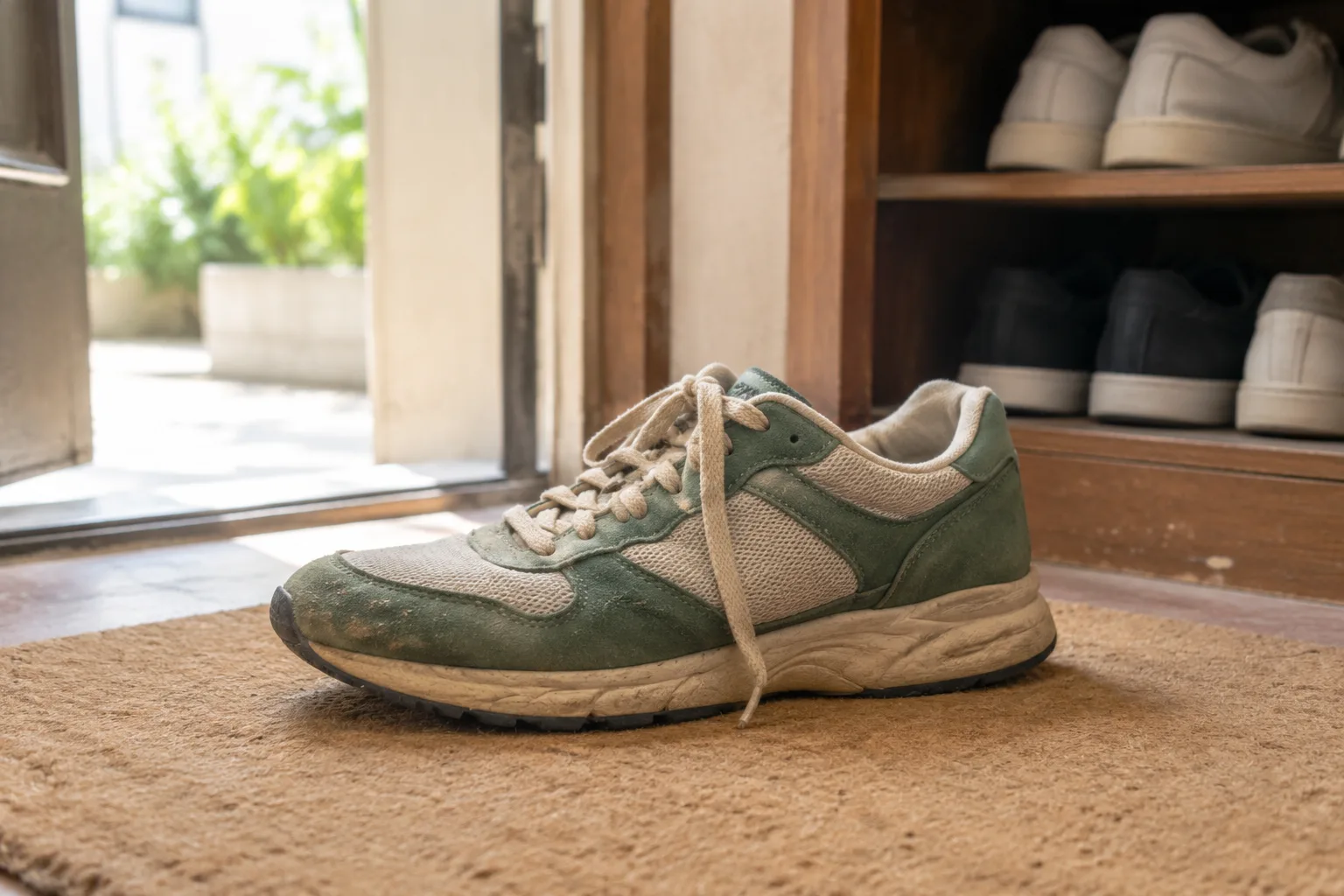
Walk into the homes of long-distance runners and there is often a pair by the door that has nothing to do with the training log. It is scuffed at the toe, the laces are slightly frayed, and the midsole has taken on the shape of a particular foot. It is almost never the newest shoe in the house.
That pair is the real answer to the daily-slot question. It is the shoe that survived the filter, the one that got worn when nothing was at stake and therefore got worn most. Retro runners keep landing in that spot because they were built for exactly that kind of unglamorous, repeated use.