
Quiet or Loud: Choosing Between Minimalist and Statement Sneakers
A white leather sneaker with a thin sole and no visible branding has become the default shoe of the well-dressed man, and the black canvas high-top with a rubber toe cap has become the default shoe of everyone else. Between those two poles sits a decision most people make without examining it, and the decision says more about how a person wants to be seen than almost any other item in a wardrobe. Minimalist or statement. Quiet or loud. The choice is real, and it is not purely aesthetic.
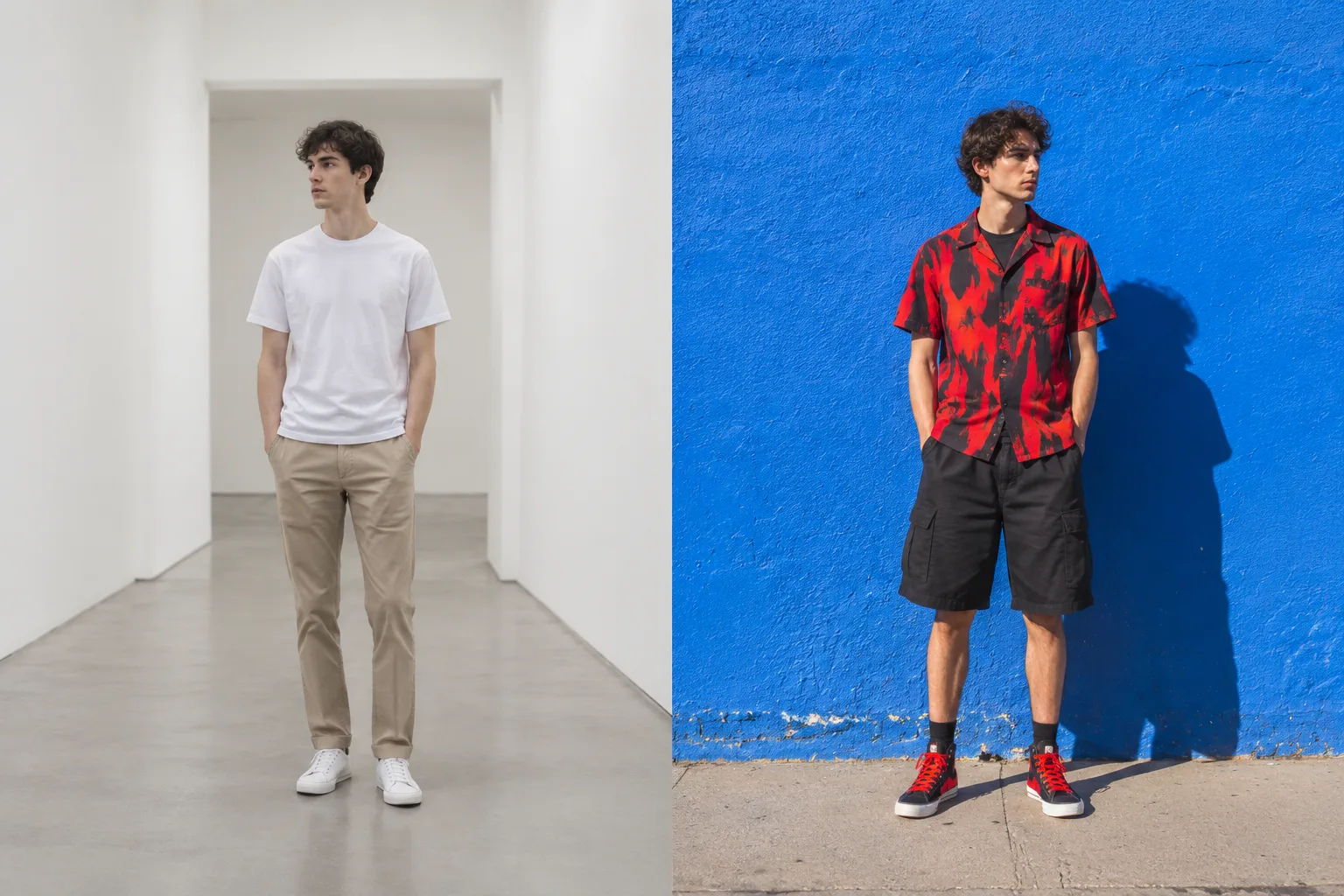
The minimalist sneaker is a specific object with a specific history. It descends from tennis and basketball shoes of the 1960s and 1970s, stripped of their original performance features and reduced to a clean upper, a flat sole, and a color palette that rarely strays past white, off-white, black, and the occasional grey. Common Projects made the template famous around 2004 with the Achilles, a plain leather shoe with a line of gold serial numbers stamped near the heel. The numbers are the only decoration. Everything else is absence.
The statement sneaker runs the other way. It is bulky, or it is brightly colored, or it has a sole thick enough to be seen from across a room. It may be a chunky runner, a retro basketball shoe in a colorway that would have been laughed out of a 1998 gym, or a skate shoe with a panel of suede in a shade that matches nothing else in the closet. The statement shoe wants attention. It is designed to be noticed before the rest of the outfit is.
What the quiet shoe actually asks of its owner
A minimalist sneaker is unforgiving in a way that statement shoes are not. There is nowhere to hide a scuff, a crease, or a dirty sole. White leather shows every mark. The shape has to be right, the fit has to be right, and the rest of the outfit has to carry the visual weight the shoe refuses to carry. A plain white sneaker under a poorly cut pair of trousers looks like a mistake. Under a good pair of trousers, it looks deliberate.
This is the trade the minimalist makes. The shoe stops being the interesting part of the outfit and becomes the neutral ground the rest of the outfit stands on. That requires the rest of the outfit to be worth standing on. It is a higher bar than it sounds, and it is why so many people buy the plain white sneaker and then wonder why it looks flat on them. The shoe did its job. The clothes around it did not.
There is also a maintenance cost that rarely gets mentioned. A white leather sneaker needs cleaning every few wears if it is going to look like the shoe in the photograph. A grey suede sneaker is more forgiving but picks up water stains. A black leather sneaker hides almost everything, which is why it has become the quiet default for people who do not want to think about their shoes on a wet Tuesday morning.
The statement shoe carries its own outfit
A loud sneaker does the opposite work. It absorbs the visual attention the rest of the outfit would otherwise have to earn. A person in plain jeans and a grey sweatshirt wearing a bright orange runner looks styled. The same person in plain jeans and a grey sweatshirt wearing a plain white sneaker looks like they got dressed in the dark. The statement shoe is a shortcut, and shortcuts are not automatically bad.
The catch is that the statement shoe has to be chosen with the same care the minimalist applies to the rest of the outfit. A loud shoe in the wrong color, or the wrong proportion, or the wrong level of loudness for the wearer's life, reads as trying too hard. The line between a statement sneaker and a costume is thin, and it moves depending on the context. A chunky runner in a bright colorway at a design studio reads as considered. The same shoe at a law firm reads as a problem.
The statement shoe also dates faster. Colorways come and go, silhouettes rise and fall, and the shoe that looked fresh in March can look tired by the following spring. The minimalist sneaker has lasted decades with only minor changes because it was designed to be boring. Boring is durable. Loud is seasonal.
The proportion problem nobody warns about
Most people choosing between the two styles focus on color and ignore proportion, which is the part that actually decides whether a shoe works. A chunky statement sneaker adds visual weight to the bottom of the body. On a tall person with long legs, that weight balances the frame. On a shorter person, the same shoe can make the legs look shorter than they are, because the eye reads the bulk of the shoe as part of the leg.
The minimalist sneaker has the opposite effect. A thin sole and a low profile lengthen the line of the leg, which is why the plain white sneaker has become so popular with people who want to look taller without wearing a heel. The trade is that the thin sole offers less cushioning and less support, and a person who spends the day on their feet will feel the difference by evening.
This is the part of the decision that has nothing to do with taste. A person who walks three miles a day on concrete needs a shoe with some substance under the foot. A person who drives to an office and sits at a desk can wear a flat leather sneaker without consequence. The body makes part of the choice before the wardrobe gets a vote.
Where the two styles meet in the middle
There is a middle category that rarely gets named, and it may be the most useful one. It includes shoes with a clean silhouette but one strong detail: a gum sole, a contrast stitch, a panel of suede in a slightly off color, a slightly thicker midsole than the pure minimalist allows. The German army trainer, a plain white leather shoe with a gum sole and a grey suede toe, sits here. So does a canvas low-top in a color that is not quite white and not quite anything else.
These shoes do the work of the minimalist, in that they do not shout, but they carry enough detail to keep the outfit from going flat. They are also more forgiving of a casual wardrobe than the pure white leather sneaker, which can look too formal against a faded t-shirt. The middle category is where most people actually end up once they have tried both extremes and found neither quite right.
The wardrobe audit that settles the question
A useful test: lay out five outfits that get worn regularly, and look at what the shoes would need to do in each one. If the outfits are mostly neutral, mostly tailored, and mostly built around two or three colors, the minimalist sneaker will slot in without friction. If the outfits are mostly casual, mostly denim, and mostly built around one strong piece, the statement sneaker will give the outfit a place to land.
The test fails when the wardrobe is mixed, which is most wardrobes. A person with a suit for work and jeans for the weekend is asking one shoe to do two jobs, and no single shoe does both well. This is the honest answer to the quiet-or-loud question: most people need one of each, and the decision is really about which one gets bought first.
What the shoe says before the person speaks
Shoes get read faster than any other item of clothing, because they sit at the bottom of the body where the eye lands last and stays longest. A plain white sneaker signals that the wearer wants to be read as someone who does not need to signal. A loud sneaker signals that the wearer wants to be read as someone with a point of view. Both signals are honest. Neither is better.
The mistake is choosing the shoe that signals a person the wearer is not. A minimalist sneaker on someone who actually wants to be noticed reads as shy. A statement sneaker on someone who wants to blend in reads as effort. The shoe has to match the wearer's actual relationship with attention, not the relationship the wearer wishes they had.
The pair that gets worn until the sole gives out
Almost everyone who has owned both styles ends up with a favorite, and the favorite is rarely the one they expected. The plain white sneaker that seemed like the safe choice turns out to be the shoe that gets worn four days a week, because it goes with everything and requires no thought at seven in the morning. Or the loud pair that seemed like a risk turns out to be the one that gets compliments and gets worn until the sole is smooth.
The shoe that survives is the one that fits the life actually being lived, not the life being imagined. A person who bought the statement sneaker for a version of themselves who goes to galleries on weekends may find it gathering dust if the weekends are actually spent at youth soccer games. A person who bought the minimalist sneaker for a version of themselves who wears tailored trousers may find it scuffed and sad if the daily uniform is actually jeans and a hoodie.
The decision between quiet and loud is settled less by taste than by honesty about which shoe will actually leave the house. Buy the one that matches the mornings that actually happen. The other pair can wait until the mornings change.