

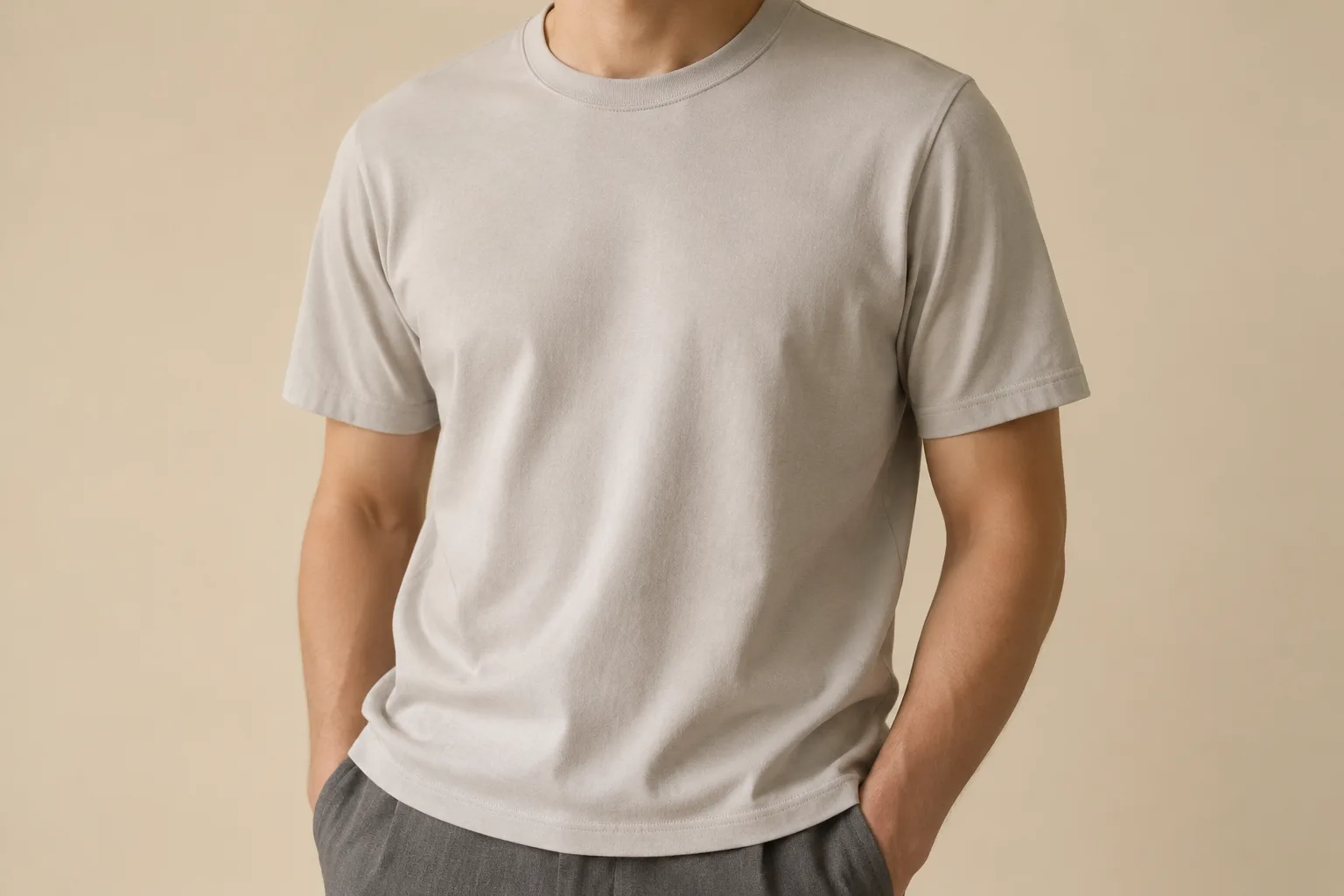
Performance Tees That Pass as Polished
A cotton t-shirt and a technical running shirt can look identical on a hanger and behave nothing alike on a body at 3 p.m. in a warm office. One has been engineered to move sweat off skin, dry in minutes, and hold a shape through a hundred washes. The other just looks the part. The phrase "performance tee" covers a wide commercial territory now, from $18 polyester basics to $90 merino blends sold in the same aisle as trail shoes. The interesting question is narrower: which of these shirts actually read as polished when they leave the gym and land somewhere with a dress code.
Polished is a specific visual outcome. It means the shirt hangs cleanly from shoulder to hem, doesn't cling or shine, holds a collar that hasn't gone floppy, and doesn't advertise itself as athletic gear. Performance fabrics fight that outcome on every front. They are thin, they catch light, they cling at the waist, and their seams tend to be designed for motion rather than for sitting behind a laptop. Getting them to pass requires understanding what each fabric does when it stops being sportswear.
The shine problem and why it gives a shirt away
Standard polyester has a low denier, a smooth surface, and a tendency to reflect light in a way cotton never does. Under office ceiling panels, that reflection reads as cheap. The fabric doesn't look wet exactly; it looks slick, like the shirt has a coating. In a photograph it can suggest a uniform or a promotional giveaway shirt.
Finer yarns and matte finishes fix most of this. A performance tee knit from a spun polyester or a polyester-cotton blend has a surface texture closer to cotton jersey, which breaks up the light. The tradeoff is weight: matte performance fabrics tend to be a little heavier, and that weight is what gives the shirt a clean drape instead of a second-skin fit. A shirt that weighs close to a standard cotton tee (roughly 150 to 180 grams per square meter) will behave much more like one.
The other giveaway is opacity. Thin performance fabric goes translucent across the chest and shoulder blades under direct light or after a wash cycle or two. A shirt that passes as polished has to hold its color against skin without visible shadow. This is where cheap athletic tees fail fastest, and why the price gap between a promotional shirt and a technical one is often really a fabric-weight gap.
Collar structure separates the gym shirt from the office shirt
A crew neck is the whole game. Performance tees are typically finished with a thin ribbed collar heat-pressed or stitched flat to the body, which is comfortable and terrible for structure. Within a few wears it curls, stretches, and starts to look like a shirt that has been slept in. The collar of a polished tee has a small band of ribbing with enough body to stand up on its own, usually around half an inch to three quarters of an inch wide, and it is sewn rather than bonded.
Collar height matters more than most people expect. A higher, tighter crew sits close to the base of the neck and frames the face; a loose, low one exposes the collarbone and reads casual. For a shirt meant to pass in an office, the collar should sit just below the throat and hold that position after twenty washes. That is a structural quality issue, and it is one of the few things a shopper can judge in the fitting room by simply stretching the collar gently and watching whether it springs back.
Seam placement is where athletic tees announce themselves
Running shirts often use raglan sleeves or shifted side seams to avoid chafing under a pack strap. These are smart choices for a trail and awkward choices for a desk. A raglan seam running from collar to underarm creates a diagonal line across the chest that no dress shirt has, and it draws the eye in a way that makes the garment look deliberate, in the wrong sense. Standard set-in sleeves with a clean shoulder seam look much more like a conventional tee.
Flatlock stitching is another tell. It is the interlocking seam used on activewear to lie flat against skin, and it produces a visible ladder of thread on the outside of the garment. On a hiking shirt that is fine. On a shirt worn to a meeting it looks like a feature nobody asked for. A clean, narrow overlock seam tucked to the inside, or a bonded seam hidden under a fold, keeps the exterior surface plain.
Hem length is the quietest detail and the one that most often ruins the look. Athletic tees are cut short so they don't bunch during movement. Tucked into trousers, a short hem pulls out the moment a person sits down. A polished performance tee needs a hem that reaches mid-fly when untucked, or enough length to stay put under a belt.
Merino wool is the fabric that solves the shine and the smell
Fine-gauge merino has become the default answer for anyone who wants performance without the synthetic look, and the reason is straightforward: the fiber is naturally matte, naturally opaque at moderate weights, and naturally resistant to odor. A 150 to 170 gram merino jersey drapes like a good cotton tee, insulates when the office air conditioning overdelivers, and does not develop the sour smell that polyester picks up after a single warm commute.
The catch is durability and price. Fine merino is delicate, prone to pilling under a bag strap, and it usually costs two to four times what a comparable synthetic costs. It also requires more careful laundering, which for many people defeats the purpose of an easy everyday shirt. Blends help: merino mixed with a small percentage of nylon or Tencel holds up better and keeps most of the matte finish, though the odor resistance drops as the wool content falls.
For a person who runs warm and works in a building with unreliable climate control, merino is the fabric most likely to look appropriate at 9 a.m. and still appropriate at 6 p.m. It is also the fabric most likely to be mistaken for an ordinary cotton tee, which is exactly the goal.
Color choice does more work than fabric technology
Heather grey is the classic performance tee color and the worst one for passing as polished. The marled texture is casual by design, and it shows every sweat mark at the chest and under the arms. Black hides sweat reasonably well but shows lint, deodorant residue, and the faint shine of synthetic fiber more than any other color. White is unforgiving on opacity.
Navy, charcoal, deep olive, and muted burgundy do the most work. They are dark enough to hide perspiration and light enough not to spotlight lint, and they read as ordinary shirting colors rather than gym colors. A solid navy performance crew, well cut, is nearly indistinguishable from a navy cotton tee at conversational distance, and it will still be dry after a fast walk to the train.
The fit that makes thin fabric look expensive
Performance fabric shows every contour, so fit has to be deliberate. A shirt that is too tight pulls across the chest and clings at the stomach; one that is too loose drapes in a way that looks like a hand-me-down. The polished fit sits close to the shoulder without pulling, has a straight drop from chest to hem rather than a taper at the waist, and leaves roughly a finger's width of ease at the side seam.
This is also why the same shirt can look sharp on one person and sloppy on another. Athletic cuts taper at the waist and flare at the chest, which suits a narrow frame and looks strained on anyone broader. A straighter, boxier cut is more forgiving and reads more formal, and it is worth seeking out even if it means sizing up and having the sleeves shortened.
Layering is the honest test of whether it passes
The real measure of a polished performance tee is what happens when it goes under something. Slip a blazer over a synthetic crew and the collar either disappears or bunches; the fabric catches on the lining, and the short athletic hem rides up the back the moment the jacket is buttoned. Under a knit sweater, a shiny technical tee creates a visible sheen at the neckline and cuffs where the sweater doesn't cover it.
A tee that works as a base layer has a collar low enough not to fight a shirt collar, a body long enough to stay tucked, and a surface smooth enough not to grab at wool or cotton above it. That combination is rare in purpose-built athletic wear and common in the better technical lifestyle lines, which are cut more like casual shirts and finished with fewer logos.
Logos, trims, and the details that undo the disguise
Branding is the fastest way to lose the argument. A reflective chest logo, a contrast side panel, or a printed sleeve stripe all say sportswear before anyone has looked at the fabric. The shirts that pass are the ones with a small tonal mark at the hem or nothing at all, and trims in the same color as the body rather than a contrasting accent.
Hardware matters too. A performance tee with a zip placket or a snap at the neckline looks like a cycling jersey. A plain crew with a clean hem and a single-color collar is the version that disappears into an outfit. The less the shirt announces itself, the more it can be worn to places where nobody is supposed to notice clothing at all.
What a person actually pays for in the end
Most of the difference between a $20 performance tee and an $80 one lives in three places: fabric weight, collar construction, and seam finishing. The expensive shirt is heavier, which makes it drape; its collar is sewn rather than bonded, which makes it survive; its seams are tucked inside, which makes it look ordinary. None of that is advanced technology, and none of it is visible on the hangtag.
The practical consequence is that a shopper can evaluate these shirts without trusting the marketing. Hold the fabric up to a window to check opacity. Stretch the collar and watch it recover. Turn the shirt inside out and look at whether the seams are bonded or stitched and whether the thread is coarse. Check the hem length against the waistband of a pair of trousers, not against a pair of shorts.
Those four checks will sort a rack of technical tees faster than any fabric name. The shirt that passes all of them will be the one that gets worn to dinner after a long walk, and nobody at the table will ask what it is made of.