

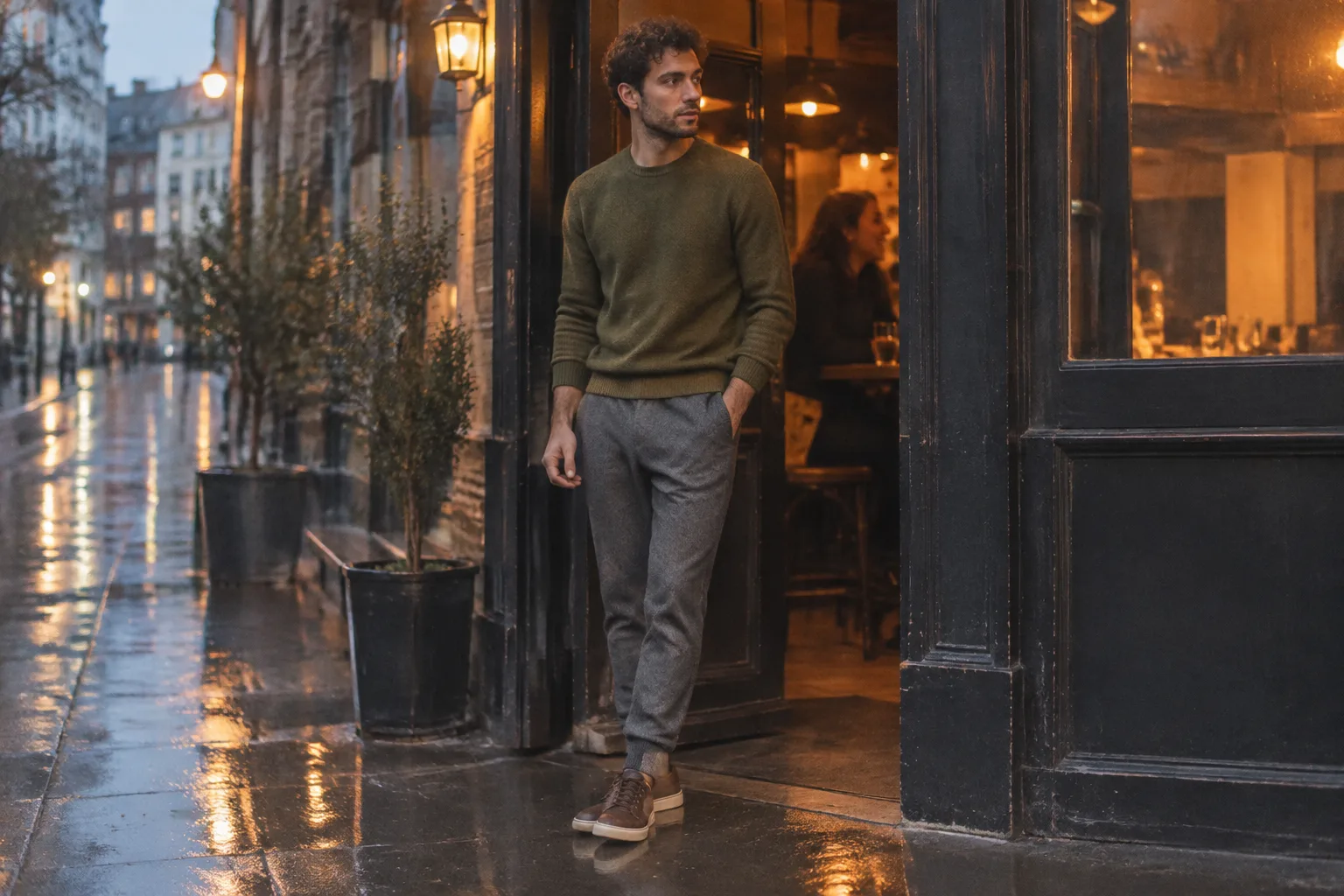
Joggers Off Duty: A Guide to Wearing Them Well
The jogger has a reputation problem, and it is mostly deserved. The garment that shows up most often in the wild is a limp, vaguely athletic trouser in heathered gray, elastic cuffs puddled over a pair of running shoes, worn by someone who has clearly given up on the day. That version exists, and it is comfortable, and it should probably stay indoors. But the jogger as a category has quietly split in two over the past decade, and the split matters for anyone trying to wear one outside a gym or a couch.
One branch is technical: nylon, polyester, sweat-wicking panels, zip pockets, a cut built for stride length. The other branch is tailored, or tries to be: wool blends, cotton twill, a taper that ends at the ankle rather than swallowing the shoe. The first is sportswear. The second is a trouser that happens to be gathered at the hem, and it is the one worth talking about here. The confusion between them is where most bad outfits begin.
Tailored joggers, when they work, work because of a single structural fact: the cuff. A gathered hem does something no straight leg can do. It pulls the eye down to the ankle, then stops it, which makes the shoe matter more than it would under a boot cut. That is a burden and an opportunity. A person wearing cuffed trousers has effectively agreed to have their footwear noticed.
The fabric decides whether the cuff reads as deliberate or as laundry day. Cotton jersey with a lot of stretch will cling and sag by mid-afternoon. A wool blend, even a cheap one with some polyester in it, holds a crease and keeps its shape through a long day. Heavier weights drape; lighter weights reveal everything underneath, which is rarely the goal.
The fit question is where most attempts fail, and it fails in one direction far more than the other. Joggers that are too loose at the thigh and too tight at the ankle produce a silhouette like a balloon tied off at the bottom. Joggers that are too tight throughout look like leggings with extra steps. The working zone is a straight or slightly tapered leg from hip to knee, with enough room to pinch an inch or two of fabric at the thigh, then a clean taper below the knee into a cuff that sits on the ankle bone and does not bunch.
Length is the detail people skip. A cuff that lands correctly shows a sliver of ankle when standing still and rides up a touch when walking. A cuff that is too long folds over itself and stacks, which reads as borrowed clothing. A cuff that is too short turns the whole thing into capri territory. Most brands cut for a 32-inch inseam and call it universal, which is a fiction. The hem can be shortened by a tailor for the price of a sandwich, and it is the highest-return alteration in menswear.
What the Cuff Does to the Rest of the Outfit
Because the hem draws attention downward, the shoe carries disproportionate weight. A sleek leather sneaker in a single color, white or black or a muted tan, keeps the line clean. A chunky running shoe with a thick foam sole fights the taper and makes the ankle look wider than it is. A loafer can work, particularly a suede one, but only if the cuff is narrow enough to sit above the shoe's collar rather than swallowing it.
Boots are trickier. A slim Chelsea boot under a tapered jogger can look sharp, provided the cuff ends above the boot's shaft. A lace-up work boot under the same trouser tends to look like a man caught between two dress codes. The general rule: the more volume the shoe has, the more the cuff needs to stay above it. A jogger tucked into a boot is almost always a mistake outside of snow.
Socks become visible in a way they are not with a straight leg. A flash of white athletic sock under a tailored jogger reads as an accident. A thin dress sock in a color close to the trouser, or no sock at all with a loafer, keeps the transition smooth. In colder months, a merino sock in a dark tone is the quiet answer.
The Top Half Has to Meet the Trouser Halfway
A jogger is casual by construction. The cuff says so. Pairing it with a blazer is a move that gets attempted often and lands rarely, because the formality of the jacket and the informality of the hem pull in opposite directions. When it does work, the jacket is unstructured, the fabric is soft, and the whole outfit leans into the contrast on purpose. A structured worsted wool blazer over a jersey jogger looks like two people sharing a body.
The safer upper half is a knit. A fine-gauge crewneck sweater, a heavyweight cotton tee, an oxford shirt with the collar open. The shirt untucked is the default; tucked in with a belt, the jogger starts to look like it is trying to be a chino, and the cuff betrays the effort. If a belt is necessary, the trouser should have belt loops, which many joggers do not, and that absence is a signal about how the garment wants to be worn.
Outerwear follows the same logic. A bomber, a chore coat, a Harrington, a padded vest: all casual, all fine. A trench coat can work if the jogger is dark and the coat is cut short. A peacoat is too much structure. The through-line is that everything above the waist should be willing to admit it is casual, because the hem already has.
Colors That Survive the Cuff
Heather gray is the default and the least interesting choice. It photographs flat, it shows every wrinkle, and it signals the gym. Charcoal, navy, olive, and black are the workhorses, and a deep brown or a rust can carry a whole outfit in fall. Lighter tones, cream or sand, are riskier because the cuff collects grime at the ankle, which is exactly where the eye is being sent.
Pattern is mostly a distraction here. A subtle herringbone or a fine stripe in a wool blend can add texture without noise. A large print or a logo down the leg turns the trouser into a billboard and undoes the tailoring. The point of a good jogger is that it reads as a plain trouser from three feet away and only reveals its cuff up close.
Where They Belong and Where They Do Not
A tailored jogger in wool or a heavy cotton blend can hold its own at a casual dinner, a gallery opening, a weekend lunch, a flight. It travels well because the cuff does not crease the way a hem does. It is forgiving on a long train ride and looks intentional in a hotel bar.
It does not belong in a meeting where someone else is wearing a suit, at a wedding, or anywhere a client might reasonably expect a pressed crease. The cuff is a casual signal, and casual signals do not negotiate. A person who wears joggers to a formal event is making a statement, and the statement is usually about the wearer rather than the occasion.
The gym version, the nylon one with the zip pockets, has its own logic and should stay in its lane. Wearing it to brunch is a choice, and it is a choice that reads as "I came from the gym" even when no gym was involved. That is a fine thing to communicate on a Saturday morning and a strange thing to communicate at a job interview.
The Ankle Is the Whole Argument
Strip away the fabric debates and the brand loyalties and the question of whether a jogger can be dressed up, and what remains is the ankle. The cuff exposes it, frames it, and makes it the terminus of the outfit. Everything above the hem is a runway leading to that point. A person who understands this stops thinking of joggers as sweatpants with ambitions and starts treating them as trousers with a built-in focal point.
That reframing changes the shopping. Instead of asking whether a pair is comfortable, the question becomes whether the cuff sits right and whether the fabric holds. Instead of buying three pairs in gray, the search narrows to one pair in a wool blend, hemmed to the ankle bone, in a color that survives a winter. The rest of the wardrobe adjusts around it, because the ankle has already decided what the outfit is going to be.
The jogger is not a compromise between a trouser and a sweatpant. It is a trouser with a specific ending, and the ending is the entire point. Get the ending right, and the rest of the garment, and the rest of the outfit, follows without much argument.