

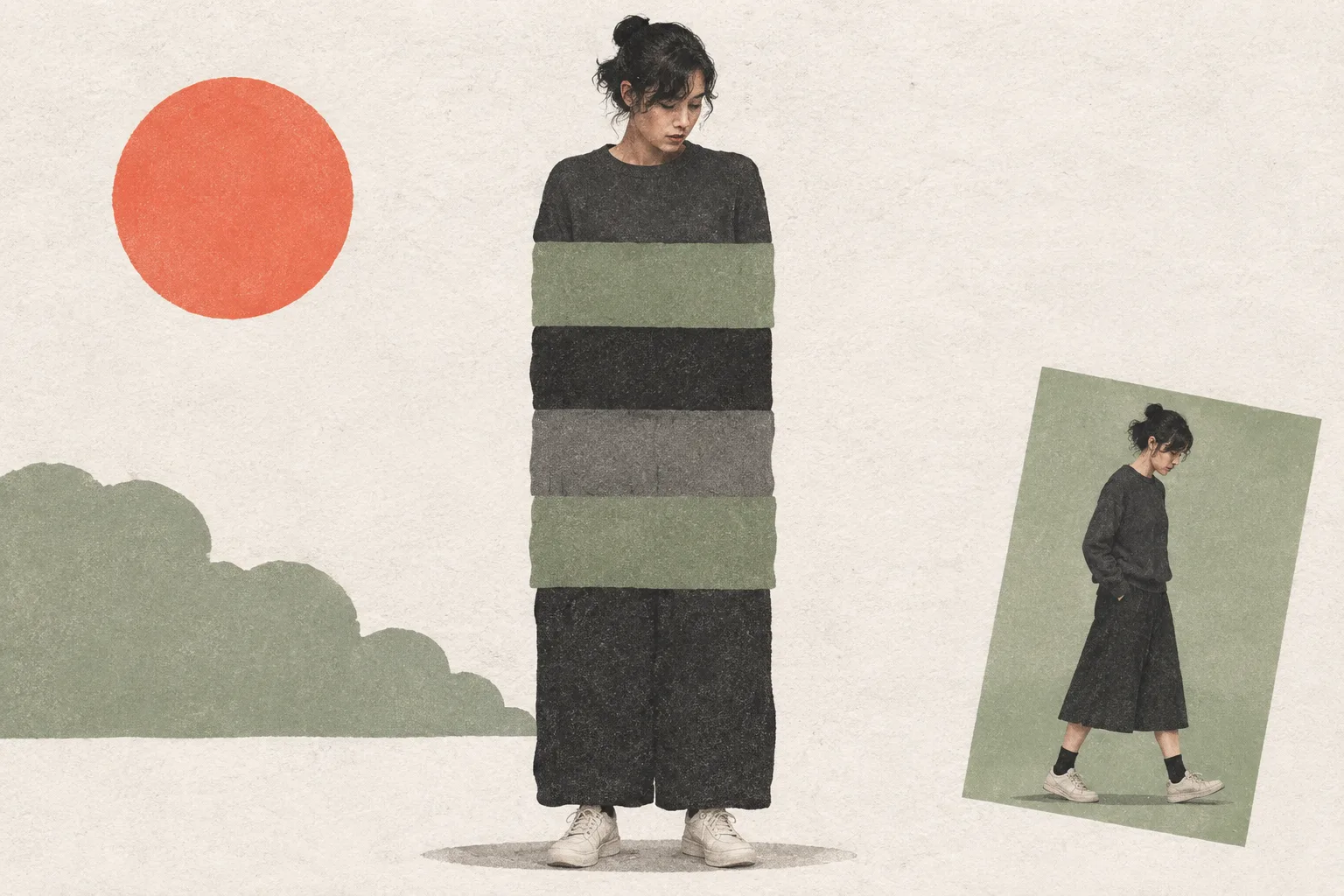
Five Activewear Layering Mistakes That Flatten an Outfit
Activewear layering fails in a handful of predictable ways, and almost none of them have to do with the clothes being cheap. A wardrobe full of technical fabric can still produce an outfit that reads flat, boxy, and vaguely apologetic, the way a runner looks when every piece was chosen for function and nothing was chosen for line. The mistakes tend to repeat: the same proportions, the same fabric weights stacked on top of each other, the same instinct to add one more piece because the mirror still looks unfinished. What follows is a look at the five that flatten an outfit most reliably, and why fixing them has less to do with buying anything new than with noticing what the mirror is actually showing.
Stacking Three Fabrics That Weigh the Same
The most common flattening happens at the fiber level. A person pulls on a cotton base layer, a cotton-blend hoodie, and a cotton windbreaker, and wonders why the whole thing looks like a single gray mass. Three fabrics of similar weight and similar drape cancel each other out. There is no tension, no contrast, nothing for the eye to catch on.
Layering works when the weights talk to each other. A thin, close-fitting merino base under a structured shell gives the silhouette two distinct textures: one that hugs and one that stands. A brushed fleece under a crisp nylon vest does the same at a bigger scale. The point is that each layer should feel like it belongs to a different climate, even if all of them were built for the same workout.
The tell is a photograph. If a single gray shape appears in the frame, with no clear break between torso, shoulder, and sleeve, the weights are too close. Introducing one lighter layer or one heavier outer shell usually solves it without adding bulk.
Treating the Hoodie as a Universal Middle Layer
The pullover hoodie has become the default middle layer for a generation of activewear, and it is the wrong choice more often than it is the right one. A hoodie adds volume at the neck and shoulder, two places where layering most easily goes wrong. The hood collapses against the back of the neck, the kangaroo pocket pushes the front of the body forward, and the ribbed hem creates a horizontal line exactly where the torso should be longest.
None of this is a problem in isolation. The problem is when a hoodie sits under a jacket, adding its bulk to the jacket's bulk, so the shoulders look padded and the torso loses its vertical line. A quarter-zip in a smooth knit, or a vest with a clean neckline, keeps the same warmth without stacking shape on top of shape.
The hoodie still has a place: as the outermost layer, where its volume becomes the silhouette rather than fighting it. Worn underneath, it usually flattens.
Wearing a Base Layer That Ends Above the Waistband
A base layer that stops just below the navel creates a visible break in the vertical line of the outfit. The eye reads the hem as an endpoint, and the torso suddenly divides into a top half and a bottom half, which shortens the whole frame. This happens almost constantly in activewear because so many base layers are cut short to sit above high-rise leggings.
Longer base layers, tunic-length or at least mid-hip, give the outfit one continuous line from shoulder to thigh. The extra fabric tucks into the waistband or falls over it, and the result is a piece that reads as a single column rather than two stacked blocks. The same logic applies to the outer layer: a jacket that stops at the natural waist, rather than the hip, will cut the body in half and make everything below it look heavier.
Length is the cheapest fix in layering and the one most people overlook. It costs nothing to choose a longer base layer; it just requires trying one on and noticing where the hem lands.
Piling Volume at the Ankles and Wrists
Layering is usually discussed from the shoulders down to the hips, and then abandoned. The ankles and wrists get whatever is left, and what is left is often a jogger cuff, a sock bunch, and a sleeve that ends mid-forearm with a watch on top of it. Each of those details is small. Together they create a cluster of horizontal breaks at the two points where the outfit most needs to taper.
Clean endings matter more than people give them credit for. A jogger cuff that sits snugly against a low-profile sock, or a sleeve that ends at the wrist with nothing layered over it, lets the eye travel the full length of the arm or leg uninterrupted. A loose cuff, a thick sock, and a chunky watch at the same joint produce a visual pile-up that pulls attention downward and makes the whole outfit look heavier than it is.
The fix is simple: choose one accessory per limb. If the watch is there, the sleeve stays clean. If the socks are the point, the cuff stays low. Two pieces competing at the same joint is one too many.
Choosing Layers That Match the Leggings Too Closely
The final and most stubborn flattening comes from tonal matching. A person wears black leggings, then a black hoodie, then a black jacket, and the entire outfit collapses into a single unbroken field of color from neck to ankle. There is nothing for the eye to rest on, no transition, no shape. The body disappears into the clothes.
Tonal dressing can work, but only when it is deliberate: when the fabrics differ enough in texture and sheen to create depth without color contrast. A matte black legging under a satin black windbreaker reads as intentional. A matte legging under a matte hoodie under a matte jacket reads as a shadow.
The easier route is a single point of contrast. One lighter layer, one warmer tone, one piece in a different value, placed where the eye should land: the torso, usually, or the outer shell. The leggings stay quiet, the base stays quiet, and the one contrasting layer gives the outfit a focal point and a shape.
Why the Mirror Reads Flat Before the Fabric Does
Most layering advice treats the problem as a matter of missing pieces. Buy a better vest, a lighter base, a more technical shell. The truth is that the flattening usually happens before any of that: at the moment the outfit is assembled, when the same three layers get reached for out of habit and the mirror is checked for fit rather than for line.
A useful exercise is to look at the outfit in silhouette only, squinting until the details blur. If the shape reads as a single rectangle from shoulder to ankle, something is flat. If it reads as a column that tapers at the waist, widens at the shoulder, and ends cleanly at the wrist and ankle, the layering is working. The silhouette test catches the weight problem, the hoodie problem, the length problem, and the tonal problem all at once, because all four of them collapse the shape in the same direction.
The squint test also reveals which single fix will do the most work. Sometimes it is a longer base layer. Sometimes it is removing the hoodie from the middle and putting it on the outside. Sometimes it is one lighter jacket. Rarely is it all five fixes at once, and rarely is it a new purchase.
The One Piece That Usually Needs Removing
If a single rule had to be pulled from all of this, it would be the removal rule. Most flattened activewear outfits have one layer too many, and the layer is usually the middle one: the hoodie under the jacket, the second tee under the vest, the long-sleeve under the sweatshirt because the morning was cold and the afternoon was not.
Removing a middle layer rarely makes a person colder in any meaningful way. It changes the silhouette more than it changes the temperature. The body keeps its heat near the skin; the layers above it are mostly there to manage moisture and wind, and two of them usually do the work of three. The outfit that loses one layer gains a waistline, a shoulder line, and a clearer vertical drop.
There is a practical test for this. Before leaving the house, a person can take off the middle layer and look again. If the outfit looks better without it, it probably is better without it, and the cold will be handled by the outer shell and the base. The mirror rarely lies about this, even when the weather report argues otherwise.