
Fabrics That Keep Their Lines All Day
Wool crepe hangs from the bolt with a weight that feels almost reluctant. Cut it into a trouser leg, press a sharp crease down the front, and something useful happens: the crease stays. Not for an hour, not until the first sit-down, but through a full day of stairs, car seats, and the particular torture of a folding chair at a long lunch. That staying power is not luck. It is the fabric doing exactly what its structure was built to do.
The phrase "keeps its lines" gets used loosely in clothing copy, usually to mean "does not look like a laundry basket by noon." The real meaning is narrower and more interesting. A fabric that holds a line resists two separate forces: the physical deformation of sitting, bending, and leaning, and the slower creep of fibers relaxing under their own weight. Some fabrics fail the first test in minutes. Others pass it and then quietly droop by evening. The best ones handle both, and they tend to share a small set of structural traits.
Why a Crease Survives in Some Cloth and Dies in Others
Three things decide whether a pressed line stays put. Fiber type sets the ceiling. Wool, especially long-staple wool, has a natural crimp and a springy recovery that wants to return to its original shape. Polyester can be heat-set into a crease that practically refuses to leave. Cotton, lovely as it is, has little memory and will happily collapse into whatever position it was last folded.
Yarn twist and weave density do the rest. A tightly twisted yarn packs more fiber into less space, which resists bending. A dense weave, whether plain or twill, gives the crease edges something to grip. Loosely woven cloth, however handsome, lets individual yarns slide past each other, and a line pressed into it has nothing holding it in place.
The third factor is finish. Worsted spinning removes short fibers and aligns the long ones parallel, which is why worsted wool trousers hold a crease far better than the soft, fuzzy woolens used for blankets. The trade-off is a slightly cooler, drier hand. That hand is the price of a line that survives the day.
Wool Crepe and the Quiet Authority of a Dense Weave
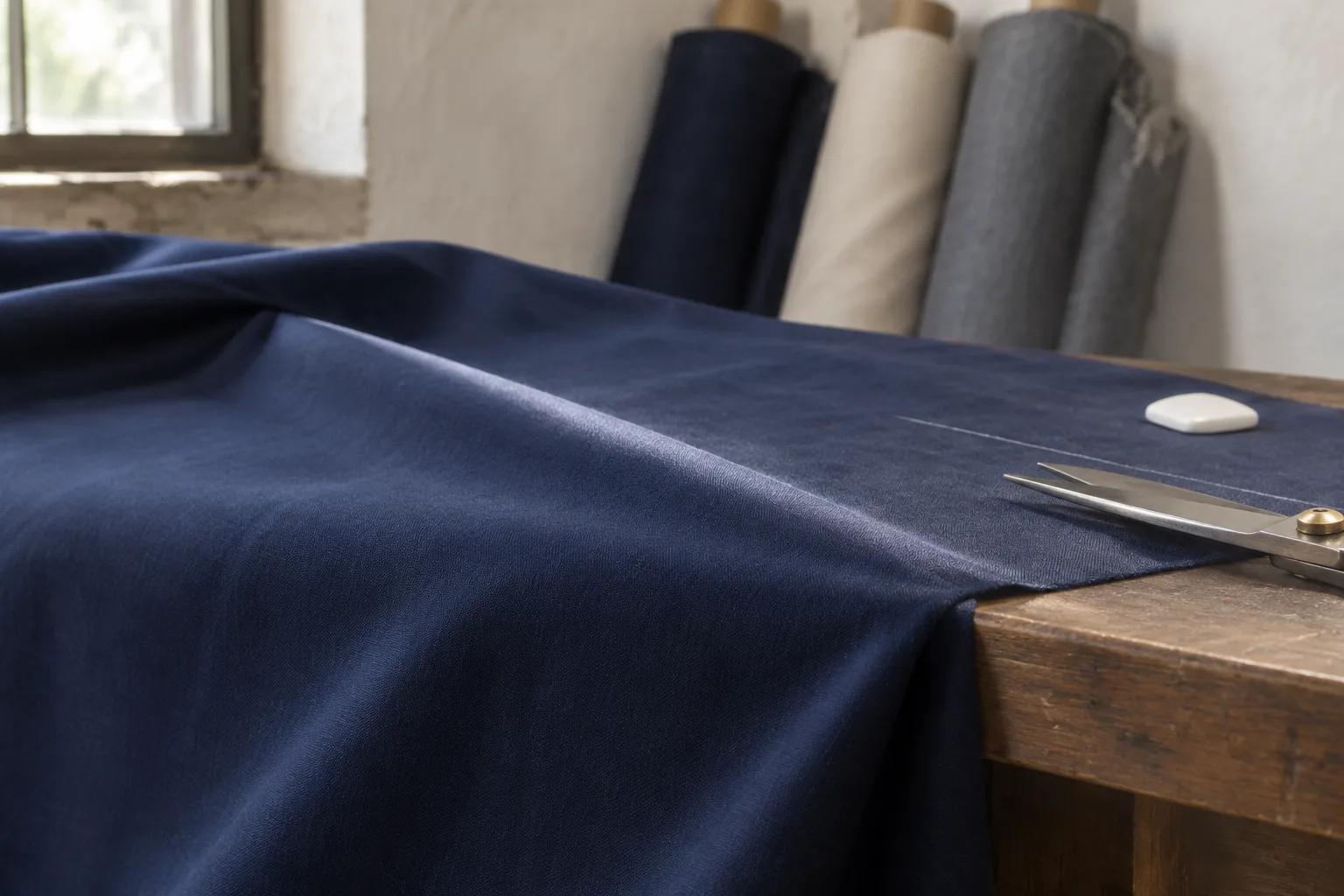
Wool crepe deserves its reputation. The yarn is over-twisted before weaving, so when the cloth relaxes off the loom it develops a subtle pebbled surface and an internal tension. That tension is the point. A crease pressed into crepe does not sit on the surface like paint; it engages the structure of the cloth, and the cloth pulls the line back into shape after every bend.
There is a reason crepe trousers have been the default for anyone who spends a day moving between meetings and taxis. The fabric forgives a full schedule. It also drapes in a way that hides the small wrinkles that do form, because the pebbled texture scatters light instead of catching it along a single fold. A flat, smooth cloth shows every crease and shadow. Crepe absorbs them.
Gabardine belongs in the same conversation. Its steep twill weave, with the diagonal wale running at a sharp angle, packs yarn densely and creates a surface that repels both wrinkles and light rain. The classic trench coat and the classic suit trouser both rely on it for the same reason: it holds a shape. Press a crease into gabardine and the twill structure locks it in. The downside is a slight stiffness that some wearers find formal. That stiffness is the mechanism working.
The Synthetic Shortcut and What It Costs
Polyester blends entered wardrobes largely because they could be heat-set into permanent creases at the factory. A pair of trousers can leave the plant with a line that will survive dozens of washings without an iron. For uniforms and budget workwear, that is a genuine advantage, and it would be dishonest to pretend otherwise.
The cost shows up in wear. Heat-set polyester creases hold their geometry but often lose their drape, hanging stiffly and shining at the knees where the fabric has been abraded. Blends with a high synthetic content also tend to trap heat and odor in a way wool does not. A wool crepe trouser may need a press now and then; a cheap polyester one will keep its line while slowly looking worse around it. The line stays, the garment does not.
A middle path exists in wool-synthetic blends, typically wool with a modest share of polyester or elastane. The wool provides recovery and hand, the synthetic adds durability and a bit of stretch. These blends hold a crease well and travel better than pure wool, which matters for anyone who folds a jacket into a bag. The trade-off is small but real: the more synthetic in the mix, the more the cloth behaves like plastic under an iron and the less it breathes.
Linen, Cotton, and the Honest Wrinkle
It would be a mistake to lump all wrinkle-prone fabrics together. Linen creases almost immediately, and that is part of its character. The rumpled look is the point, a signal of ease and warm weather. Pressing linen into a knife-sharp line is a losing battle, and a garment that fights its own nature looks worse than one that accepts it. Linen keeps its lines in the sense of holding a silhouette, not a crease.
Cotton sits between the extremes. A tightly woven cotton poplin, especially with a resin finish, can hold a crease through a workday, which is why dress shirts in poplin look crisp at the collar and cuffs. But cotton trousers without a finish will bag at the knee by mid-afternoon. The fabric has recovery, just not much, and it needs help from construction: a lined waistband, a crease pressed with steam and a pressing cloth, a bit of stiffness in the cloth itself.
The Press Matters as Much as the Cloth
A beautiful worsted wool trouser pressed badly will still droop. The iron has to be hot enough to relax the fibers but not so hot that it scorches or glazes them. Steam is essential; it penetrates the yarn and lets the fibers reset. A pressing cloth protects the surface. And the crease must be set while the cloth is still warm and then left to cool flat, because the shape is locked in as the fibers cool, not as they are pressed.
This is why a tailor's press, with its heavy plates and vacuum table, produces a line that a home iron struggles to match. The weight and the controlled cooling do as much work as the heat. A home iron can get close with patience: press, hold, let cool, repeat. Rushing the cooling step is the most common reason a home-pressed crease fades by lunch.
Reading a Bolt Before It Becomes a Garment
Anyone choosing fabric for trousers or a structured skirt can test for line-holding before committing. Hold a corner of the cloth and crush it in a fist for a few seconds, then release. A fabric with good recovery springs back toward flat. One that stays crumpled will behave the same way on a body. The test is crude but reliable, and it takes less time than reading a fiber content label.
A second check is to look at the weave against a light. Dense cloth blocks most of it. If individual yarns are easy to count and daylight pours through the gaps, the fabric will struggle to hold a sharp line. A milled, slightly felted surface on a worsted wool is a good sign too; it means the cloth has been finished to close up the structure.
Weight is the third signal, though a subtle one. Mid-weight cloth, roughly the heft of a good suit trouser, holds a line better than lightweight cloth of the same fiber and weave, because there is simply more material resisting the bend. Summer-weight wool can still hold a crease if the twist and weave are tight, but the margin for error shrinks.
The Line as a Daily Contract
A pressed crease is a small promise a garment makes at the start of the day: that it will look intentional at the end of it. Most fabrics break that promise quietly, bagging at the knee or softening along the thigh until the line is a memory. The ones that keep it are not mysterious. Wool crepe, gabardine, tightly woven worsted, a well-finished poplin: each holds its shape because its structure was built to resist the body's constant bending.
The next time a pair of trousers still shows a clean line at six in the evening, it is worth noticing. That line is the visible result of fiber, twist, weave, and finish all agreeing with each other. It is also a quiet argument for paying attention to cloth before a garment is cut, because no amount of good tailoring rescues a fabric that has already decided to collapse.